
A Chiastic Reconfiguration Of Isaiah 2-4
Kuruvilla Thomas
Bangalore
Published on 22 August 2025
Introduction
This study treats Isaiah 2-4 as a cryptochiasmus in order to arrive at a coherent reconfiguration of the text ( see definition of cryptochiasmus in [1] ). If you wish to skip the technicalities of a chiastic parse, you may read starting from Section 4 of the Discussion section, which has the reconfigured text.
Isaiah 2-4 predicts Israel's hegemony during Christ's Millennial Reign and God's humbling of the wicked during the Final Tribulation. The prophecy also details the reasons for God's punishment of Judea through the Romans.
Discussion
1. Presuppositions
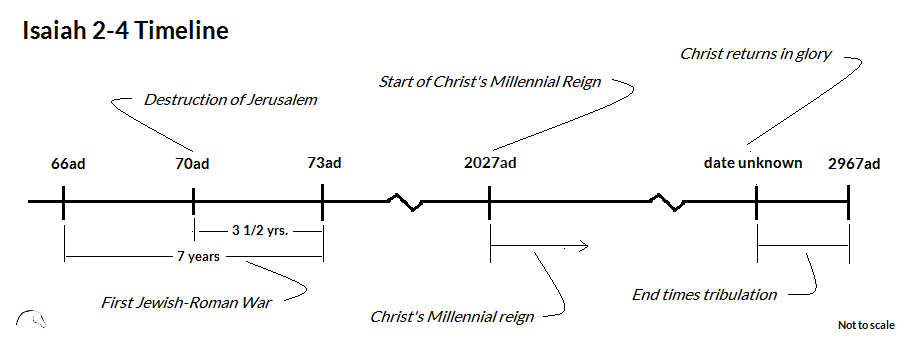
We base our parse of Isaiah 2-4 on the assumption that it refers to 3 periods:
- The First Jewish–Roman War (66AD–73AD).
- The Millennial Reign of Christ and his Messiah (from 2026AD).
- The Final Tribulation (before 2967AD).
2. Parsing the chiasmus
We will use the NIV Bible for this parse.
Parsing this chiasmus involves dividing portions of the text into the three categories above. We will call the period of First Jewish–Roman War Period 1, Christ's Millennial Reign Period 2 and the Final Tribulation Period 3.
Categorizing Isaiah 2-4
Ch 2 Vs 2-6 belong to Period 2. Christ and his Messiah will rule the world from the New Israel during the Millennial Reign.Ch 2 Vs 7-22 belong to Period 3. Arrogant idolaters are humbled during the Final Tribulation.
Ch 3 belong to Period 1. The sins and punishment of Judah and Jerusalem during the First Jewish–Roman War, with a focus on the sins of the leaders and the women.
Ch 4 Vs 1 appears to belong to Period 3. Reformed women seek to associate with righteous men to mitigate their disgrace - see commentary below. ( Though this verse comes immediately after the passage on the vanity of the women of Jerusalem in Ch. 3, we do not believe it applies to them, as the women in 70AD were either killed or taken into slavery. Also, we need a passage about Period 3 here to complete the cryptochiasmus.)
Ch 4 Vs 2-6 belong to Period 2. Christ will reign over a glorious New Israel.
Original text
We color-code the chiastic units of the original text (NIV) below for easy visual identification using: red for Period 1, blue for Period 2 and green for Period 3. We have retranslated parts of the text.
Isaiah 2 2 In the last days
the mountain of the Lord’s temple will be established as the highest of the mountains; it will be exalted above the hills, and all nations will stream to it.
3 Many peoples will come and say,
“Come, let us go up to the mountain of the Lord, to the temple of the God of Jacob. He will teach us his ways, so that we may walk in his paths.” The law will go out from Zion, the word of the Lord from Jerusalem. 4 He will judge between the nations and will settle disputes for many peoples. They will beat their swords into plowshares and their spears into pruning hooks. Nation will not take up sword against nation, nor will they train for war anymore.
5 Come, descendants of Jacob, let us walk in the light of the Lord.
6 You, Lord, have abandoned your people, the descendants of Jacob. They are full of superstitions from the East; they practice divination like the Philistines and embrace pagan customs.
7 Their land is full of silver and gold; there is no end to their treasures. Their land is full of horses; there is no end to their chariots. 8 Their land is full of idols. They [a] bow down to the work of their hands, to what their fingers have made. 9 People [b] will be brought low and everyone humbled— they cannot be forgiven [c].
10 Go into the rocks, hide in the ground from the fearful presence of the Lord and the splendor of his majesty! 11 The eyes of the arrogant will be humbled and human pride brought low; the Lord alone will be exalted in that day.
12 The Lord Almighty has a day in store for all the proud and lofty, for all that is exalted (they [d] will be humbled), 13 for all the cedars of Lebanon, tall and lofty, and all the oaks of Bashan, 14 for all the towering mountains and all the high hills, 15 for every lofty tower and every fortified wall, 16 for every trading ship and every stately vessel. 17 The arrogance of man will be brought low and human pride humbled; the Lord alone will be exalted in that day, 18 and the idols will totally disappear.
19 People will flee to caves in the rocks and to holes in the ground from the fearful presence of the Lord and the splendor of his majesty, when he rises to shake the earth.
20 In that day people will throw away to the moles and bats their idols of silver and idols of gold, which they made to worship. 21 They will flee to caverns in the rocks and to the overhanging crags from the fearful presence of the Lord and the splendor of his majesty, when he rises to shake the earth. 22 Stop trusting in mere humans, who have but a breath in their nostrils. Why hold them in esteem?
Retranslation notes for Isaiah 2
[a] vs 8 "idols. They" instead of "idols; they".
[b] vs 9 "People" instead of "So people".
[c] vs 9 "they cannot be forgiven" instead of "do not forgive them".
[d] vs 12 "they" instead of "and they".
Isaiah 3 See now, the Lord, the Lord Almighty, is about to take from Jerusalem and Judah both supply and support: all supplies of food and all supplies of water, 2 the hero and the warrior, the judge and the prophet, the diviner and the elder, 3 the captain of fifty and the man of rank, the counselor, skilled craftsman and eloquent orator [a].
4 “I will make mere youths their officials; children will rule over them.”
5 People will oppress each other— man against man, neighbor against neighbor. The young will rise up against the old, the nobody against the honored.
6 A man will seize one of his brothers in his father’s house, and say, “You have a cloak, you be our leader; take charge of this heap of ruins!” 7 But in that day he will cry out, “I have no remedy. I have no food or clothing in my house; do not make me the leader of the people.”
8 Jerusalem will stagger and Judah will fall, because [b] their words and deeds are against the Lord, defying his glorious presence. 9 The look on their faces testifies against them; they parade their sin like Sodom; they do not hide it. Woe to them! They have brought disaster upon themselves.
10 Tell the righteous it will be well with them, for they will enjoy the fruit of their deeds. 11 Woe to the wicked! Disaster is upon them! They will be paid back for what their hands have done.
12 Youths tyrannize my people, women rule over them. My people, your guides mislead you; they confuse the direction of your paths [c].
13 The Lord takes his place in court; he rises to judge the people. 14 The Lord enters into judgment against the elders and leaders of his people: “It is you who have ruined my vineyard; the plunder from the poor is in your houses. 15 What do you mean by crushing my people and grinding the faces of the poor?” declares the Lord, the Lord Almighty.
16 The Lord says, “The women of Zion are haughty, walking along with outstretched necks, flirting with their eyes, strutting along with swaying hips, with ornaments jingling on their ankles. 17 Therefore the Lord will bring sores on the heads of the women of Zion; the Lord will make their scalps bald.”
18 In that day the Lord will snatch away their finery: the bangles and headbands and crescent necklaces, 19 the earrings and bracelets and veils, 20 the headdresses and anklets and sashes, the perfume bottles and charms, 21 the signet rings and nose rings, 22 the fine robes and the capes and cloaks, the purses 23 and mirrors, and the linen garments and tiaras and shawls.
24 Instead of fragrance there will be a stench; instead of a sash, a rope; instead of well-dressed hair, baldness; instead of fine clothing, sackcloth; instead of beauty, branding. 25 Your men will fall by the sword, your warriors in battle. 26 The gates of Zion will lament and mourn; destitute, she will sit on the ground.
Retranslation notes for Isaiah 3
[a] vs 3 "eloquent orator" instead of "clever enchanter". From the KJV.
[b] vs 8 "Jerusalem will stagger and Judah will fall, because" instead of "Jerusalem staggers, Judah is falling;".
[c] vs 12 "Youths tyrannize my people, women rule over them. My people, your guides mislead you; they confuse the direction of your paths" instead of "Youths oppress my people, women rule over them. My people, your guides lead you astray; they turn you from the path".
Isaiah 4 1 In that day seven women will take hold of one man and say, “We will eat our own food and provide our own clothes; only let us be called by your name. Take away our disgrace!”
2 In that day the Branch of the Lord will be beautiful and glorious, and the fruit of the land will be the pride and glory of the survivors in Israel. 3 Those who are left in Zion, who remain in Jerusalem, will be called holy, all who are recorded among the living in Jerusalem. 4 The Lord will wash away the filth of the women of Zion; he will cleanse the bloodstains from Jerusalem by a spirit of judgment and a spirit of fire. 5 Then the Lord will create over all of Mount Zion and over those who assemble there a cloud of smoke by day and a glow of flaming fire by night; over everything the glory will be a canopy. 6 It will be a shelter and shade from the heat of the day, and a refuge and hiding place from the storm and rain.
3. Building the reconfigured text
From this parse, it appears that Isaiah 2-4 forms a cryptochiasmus as below:A1 Ch 2 Vs 2-6 Period 2. The Millennial Reign of Christ
B1 Ch 2 Vs 7-22 Period 3. The End-Times Tribulation
X Ch 3 Period 1. The First Jewish–Roman War
B2 Ch 4 Vs 1 Period 3. Women seek "marriage" with righteous men
A2 Ch 4 Vs 2-6 Period 2. Christ reigns over a glorious Israel
We now reconfigure the passages in the right order based on the chiastic structure above and based on the ordering rules of a cryptochiasmus [1].
We lead with central pivot point 'X'. The corresponding subunits (for example; subunit A1 corresponds to A2) are placed contiguously to form units (for example, A1,A2 is a unit) so that we get a list of such units.
The sequence selected for rearrangement is:
X [A1,A2] [B1,B2] (1)
Translating (1) into verse numbers, we get:
Ch 3 [Ch 2 Vs 2-6, Ch 4 Vs 2-6] [Ch 2 Vs 7-22, Ch 4 Vs 1] (2)
We arrive at the reconfigured passage in the next section by rearranging the verses so they are in sequence (2).
4. Isaiah 2-4 Reconfigured
The First Jewish–Roman War (66AD–73AD) (Ch 3)Chiasmus 1: God takes away competent leadership from the Judahites (3:1-8)
Chiasmus 2: The Judahites are wicked (3:9-15)
Chiasmus 3: The vain and haughty women of Jerusalem (3:16-26)
The Millennial Reign of Christ and his Messiah (from 2026AD) (Ch 2 Vs 2-6, Ch 4 Vs 2-6)
The Final Tribulation (before 2967AD) (Ch 2 Vs 7-22, Ch 4 Vs 1)
Chiasmus 1: Those who became wealthy through idol-worship are punished (2:7-9)
Chiasmus 2: The arrogant and the powerful are humbled (2:10-19)
Chiasmus 3: Some are reformed during the End-Times Tribulation (2:20-22, 4:1)
5. A Commentary on the Reconfigured Text
5.0 Introductory Statement
Chapter 2 1 This is what Isaiah son of Amoz saw concerning Judah and Jerusalem:
This prophecy has one of the more detailed predictions about Judea and Jerusalem at the time of the First Jewish–Roman War in 70AD. The prophecy also makes predictions regarding the Israelites during the Millennial Reign and of those outside the New Israel during the Final Tribulation. ( This introductory verse, 2:1, lies outside the cryptochiasmus.)
5.1 The First Jewish–Roman War (66AD–73AD) (Ch 3)
This Period is structured as a series of 3 chiasmi that are regarding the punishment of the Judahites.Chiasmus 1: God takes away competent leadership from the Judahites (3:1-8)
A1 3:1-4 God takes away both supplies and leadership from the wicked Judahites
X 3:5 The land descends into anarchy
A2 3:6-8 God takes away both supplies and leadership from the wicked Judahites
Subunit A1: God takes away both supplies and leadership from the wicked Judahites (3:1-4)
Chapter 3 1 See now, the Lord, the Lord Almighty, is about to take from Jerusalem and Judah both supply and support: all supplies of food and all supplies of water,
During the First Jewish-Roman war, the land of Judea experienced famine and drought (see also Joel 1:10-12,17-20). In addition, during the siege of Jerusalem, supplies of food were intentionally burned by Judahite factions to induce the defenders to fight against the siege; as a result many city dwellers and soldiers starved to death. (See our parse on the "70 Weeks of Daniel" [2] for a more detailed historical background on this period.)
Chapter 3 2 the hero and the warrior, the judge and the prophet, the diviner and the elder, 3 the captain of fifty and the man of rank, the counselor, skilled craftsman and eloquent orator. 4 “I will make mere youths their officials; children will rule over them.”
Those Judahites who were wise and capable leaders were taken away by God - the remaining men lacked experience and skill ('youths' or 'children'). It may be that many of the wiser Judahites heeded Jesus exhortation to flee as soon as they saw the Romans. Also, the Roman governor Gessius Florus had arrested and crucified many Judahite leaders at the start of the war.
Pivot X: The land descends into anarchy (3:5)
Chapter 3 5 People will oppress each other— man against man, neighbor against neighbor. The young will rise up against the old, the nobody against the honored.
Jerusalem and Judea went into a state of lawlessness, because God had taken away its supplies and all its able leadership. Also, the various Judahite factions had their own bands of soldiers who sometimes fought each other, even during the Roman siege.
Subunit A2: God takes away both supplies and leadership from the wicked Judahites (3:6-8)
Chapter 3 6 A man will seize one of his brothers in his father’s house, and say, “You have a cloak, you be our leader; take charge of this heap of ruins!” 7 But in that day he will cry out, “I have no remedy. I have no food or clothing in my house; do not make me the leader of the people.”
The people were desperate for good leadership. They tried to make leaders out of those who had some semblance of wealth and respectability - someone who inherited an estate ("father's house") and had decent clothes ("you have a cloak") - but no one was willing or able to take up the responsibility.
Chapter 3 8 Jerusalem will stagger and Judah will fall, because their words and deeds are against the Lord, defying his glorious presence.
The wicked Judahites were punished because they sinned against the Lord in word and deed - they followed Satanic doctrines and even worshipped other gods (see also Zeph. 1:4-9, Matt 23).
Chiasmus 2: The Judahites are wicked (3:9-15)
A1 3:9-11 The Judahites are wicked, and they will be punished
X 3:12 The Judahites have been led astray by bad leaders
A2 3:13-15 The Judahites are wicked, and they will be punished
Subunit A1: The Judahites are wicked, and they will be punished (3:9-11)
Chapter 3 9 The look on their faces testifies against them; they parade their sin like Sodom; they do not hide it. Woe to them! They have brought disaster upon themselves.
The look on the Judahites' faces is one of impudence, as they sin openly and without remorse or shame, like the people of Sodom. They will be severely punished for it.
Chapter 3 10 Tell the righteous it will be well with them, for they will enjoy the fruit of their deeds 11 Woe to the wicked! Disaster is upon them! They will be paid back for what their hands have done.
Righteous Judahites are saved, as they take Jesus' advice to flee to the mountains when they see the Roman soldiers arrive (Matt 24:15-20); they will go on to establish the worldwide church ("the fruit of their deeds"). On the other hand, God punishes the wicked Judahites through the Romans.
Pivot X: The Judahites have been led astray by bad leaders (3:12)
Chapter 3 12 Youths tyrannize my people, women rule over them. My people, your guides mislead you; they confuse the direction of your paths.
Before the war, the Judahites had unwise leadership ("youths", "women") that tyrannized them, and led them into wicked, Satanic doctrines and away from Jesus' message (see also Isaiah 28:7-19).
This pivot can be considered introductory to this chiasmus.
Subunit A2: The Judahites are wicked, and they will be punished (3:13-15)
13 The Lord takes his place in court; he rises to judge the people. 14 The Lord enters into judgment against the elders and leaders of his people: “It is you who have ruined my vineyard; the plunder from the poor is in your houses. 15 What do you mean by crushing my people and grinding the faces of the poor?” declares the Lord, the Lord Almighty.
The Judahite class of elders and leaders (primarily the Pharisees and Scribes) were corrupt. They placed the Judahites under oppressive laws (Matt 23:4) and abused their position to take advantage of the poor. They will be judged by God and punished for it.
Chiasmus 3: The vain and haughty women of Jerusalem (3:16-26)
A1 3:16-17 The punishment of Jerusalem's haughty women
X 3:18-23 The vanity of Jerusalem's women
A2 3:24-26 The punishment of Jerusalem's haughty women
Subunit A1: The punishment of Jerusalem's haughty women (3:16-17)
Chapter 3 16 The Lord says, “The women of Zion are haughty, walking along with outstretched necks, flirting with their eyes, strutting along with swaying hips, with ornaments jingling on their ankles.
The women of Jerusalem had become excessively haughty, immoral and immodest ("flirting, strutting, swaying hips...", "outstretched necks" to attract attention), so God punished them through the Roman attack.
Chapter 3 17 Therefore the Lord will bring sores on the heads of the women of Zion; the Lord will make their scalps bald.”
The few of them that remained alive were taken away as slaves, and they faced the humiliation and suffering of slaves ("sores on the heads...."). This passage continues in Subunit A2 below.
Pivot X: The vanity of Jerusalem's women (3:18-23)
Chapter 3 18 In that day the Lord will snatch away their finery: the bangles and headbands and crescent necklaces, 19 the earrings and bracelets and veils, 20 the headdresses and anklets and sashes, the perfume bottles and charms, 21 the signet rings and nose rings, 22 the fine robes and the capes and cloaks, the purses 23 and mirrors, and the linen garments and tiaras and shawls.
The jewellery, cosmetics and fine clothes worn by the inordinately vain women of Jerusalem are detailed in this list - they are some of the typical eastern forms of feminine adornment. All of this was taken away from them during the Roman attack ("In that day", where "day" represents the period of the war).
Subunit A2: The punishment of Jerusalem's haughty women (3:24-26)
This subunit continues from the corresponding Subunit A1.
Chapter 3 24 Instead of fragrance there will be a stench; instead of a sash, a rope; instead of well-dressed hair, baldness; instead of fine clothing, sackcloth; instead of beauty, branding.
As punishment for their sins, the women of Jerusalem that were not brutally killed were led away into slavery and faced its indignities ("stench, ropes, baldness, sackcloth, branding").
Chapter 3 25 Your men will fall by the sword, your warriors in battle. 26 The gates of Zion will lament and mourn; destitute, she will sit on the ground.
This passage is addressed to the women of Jerusalem. Their menfolk will be killed, including the irregular troops that defend Jerusalem. Their people will lament and mourn the devastation of their city (the "gates of the city", public meeting places, represent the community of wicked Judahites that were still alive; "sit on the ground" indicates great lamentation). Remarkably, in the Roman medals commemorating the defeat and captivity of Judea and Jerusalem, Judea is represented by a grieving female sitting under a palm tree, with the inscription: Judea Capta.
5.2 The Millennial Reign of Christ and his Messiah (from 2026AD) (Ch 2 Vs 2-6, Ch 4 Vs 2-6)
This Period is arranged in the form of a two-unit chiasmus:A1 2:2-3 Christ is a spiritual and political leader: To the world
B1 2:4 The glorious reign of the Messiah: The earth is at peace
X 2:5-6 Israel turns away from idolatry
B2 4:2-3 The glorious reign of the Messiah: Israel is fruitful and righteous
A2 4:4-6 Christ is a spiritual and political leader: To Israel
In this Period, we take "Mount Zion" and "Jerusalem" to synecdochically represent all of the New Israel.
Subunit A1: Christ is a spiritual and political leader: To the world (2:2-3)
Chapter 2 2 In the last days
the mountain of the Lord’s temple will be established
as the highest of the mountains;
it will be exalted above the hills,
and all nations will stream to it.
3a Many peoples will come and say,
“Come, let us go up to the mountain of the Lord,
to the temple of the God of Jacob.
He will teach us his ways,
so that we may walk in his paths.”
During the Millennial Reign of Christ (the "last days" of this passage), the reconstituted Israel will be a spiritual mountain towering above all nations and institutions around it ("mountain" is figurative here). Israel, the location of God's temple on earth, will be a highly regarded source of spiritual wisdom from God (see also Isaiah 60:3, Jer. 3:17). (The passage in 2:2-4 is virtually identical to Micah 4:1-3, which is a part of our parse of Micah 4&5 [3].)
Chapter 2 3b The law will go out from Zion, the word of the Lord from Jerusalem.
Christ will rule the world from the New Israel ("Jerusalem") through his Messiah (see also Isaiah 11:4).
Subunit B1: The glorious reign of the Messiah: The earth is at peace (2:4)
Chapter 2 4 He will judge between the nations
and will settle disputes for many peoples.
They will beat their swords into plowshares
and their spears into pruning hooks.
Nation will not take up sword against nation,
nor will they train for war anymore.
The Messiah, on Christ's behalf, will be de facto ruler of the world and so will judge international disputes. There will be no more cause for war or even for arming and preparing for war, because Christ will have complete control over world affairs - this will be a period of true peace on earth ("They will beat their swords into plowshares...") (see also Isa. 11:6, Micah 4:3).
Pivot X: Israel turns away from idolatry (2:5-6)
Chapter 2 5 Come, descendants of Jacob,
let us walk in the light of the Lord.
6 You, Lord, have abandoned your people,
the descendants of Jacob.
They are full of superstitions from the East;
they practice divination like the Philistines
and embrace pagan customs.
The people of the Northern Tribes ("Jacob") will return to their God at the start of Christ's Millennial Reign (see Romans 11:26). For more than 2700 years, God had hidden His face from the Israelites of the Northern Tribes because of the waywardness of their forefathers, and so they followed pagan religions and occult practices from the East during that time (see Deut. 28:36, Romans 11:25).
This pivot can be considered introductory to this chiasmus.
Subunit B2: The glorious reign of the Messiah: Israel is fruitful and righteous (4:2-3)
Chapter 4 2 In that day the Branch of the Lord will be beautiful and glorious, and the fruit of the land will be the pride and glory of the survivors in Israel.
During the Millennial Reign of Christ, the coming Messiah ("Branch"), through his actions, will be a magnificent representative of God. The good things that come out of Israel ("fruit of the land") under the leadership of the Messiah for the benefit of the world will be the pride and glory of the Israelites. The word "Branch" refers to the coming Messiah - he is a "Shoot" ("Branch" may be better rendered "Shoot") from the dormant root of David's line (see Isaiah 11:1, Jer. 23:5-6...).
Chapter 4 3 Those who are left in Zion, who remain in Jerusalem, will be called holy, all who are recorded among the living in Jerusalem.
The people of Israel ("Zion", "Jerusalem" represent all of Israel) will be called "holy", indicating that they will all be dedicated to doing God's work on earth. Israel will be purged during the period of Jacob's trouble (see Jeremiah 30:7), and only those who are judged worthy will remain in the New Israel (the "survivors" of 4:2, "Those who are left", "recorded among the living"). .
Subunit A2: Christ is a spiritual and political leader: To Israel (4:4-6)
Chapter 4 4 The Lord will wash away the filth of the women of Zion; he will cleanse the bloodstains from Jerusalem by a spirit of judgment and a spirit of fire.
Christ will make the Israelite women (and men) aware of their spiritual shortcomings through a "spirit of judgement", and he will purify them of their sins ("wash away their filth/cleanse the bloodstains") through a "spirit of fire" (see also Isaiah 30:20-21). Note that "Zion" and "Jerusalem" represent all of Israel.
Chapter 4 5 Then the Lord will create over all of Mount Zion and over those who assemble there a cloud of smoke by day and a glow of flaming fire by night; over everything the glory will be a canopy. 6 It will be a shelter and shade from the heat of the day, and a refuge and hiding place from the storm and rain.
God will politically lead the Israelites ("Mount Zion" represents all of Israel) at all times during the Millennial Reign (as indicated by the "cloud of smoke" and "flaming fire" - see also Exodus 13:21-22). God will protect the Israelites ("the glory will be a canopy") from wicked nations ("heat of day" and "storm and rain" represent the attacks of political enemies) (see also Isaiah 27:3).
5.3 The Final Tribulation (before 2967AD) (Ch 2 Vs 7-22, Ch 4 Vs 1)
This Period is structured as a series of 3 chiasmi that are regarding the humbling of the wicked during the End-Times Tribulation that occurs after the righteous are raptured.Chiasmus 1: Those who became wealthy through idol-worship are punished (2:7-9)
A1 2:7 The wicked wealthy will be humbled
X 2:8 Many around the world worship demon gods
A2 2:9 The wicked wealthy will be humbled
Subunit A1: The wicked wealthy will be humbled (2:7)
Chapter 2 7 Their land is full of silver and gold; there is no end to their treasures. Their land is full of horses; there is no end to their chariots.
Many around the world will be extremely wealthy ("silver and gold", "treasure") through their worship of demon gods (see 1 Timothy 6:10), and they will have all the trappings of wealth ("horses" and "chariots" represent their lavish lifestyle). But, because of their wickedness, they have been left behind on earth after the rapture, and they will now be punished (see subunit A2 below).
Pivot X: Many around the world worship demon gods (2:8)
Chapter 2 8 Their land is full of idols. They bow down to the work of their hands, to what their fingers have made.
Many outside Israel will worship demon gods and bow down to man-made idols (see also Rev 22:15), even though the whole world has been made fully aware of the One True God (see Matthew 24:14).
This pivot can be considered introductory to this chiasmus.
Subunit A2: The wicked wealthy will be humbled (2:9)
This subunit continues from the corresponding subunit A1 above.
Chapter 2 9 People will be brought low and everyone humbled— they cannot be forgiven.
These wealthy, wicked idol-worshippers, will be humbled and punished during the Final Tribulation.
Chiasmus 2: The arrogant and the powerful are humbled (2:10-19)
A1 2:10 The wicked hide from the presence of the Lord
B1 2:11 The arrogant are punished
X 2:12-16 The powerful are humbled
B2 2:17-18 The arrogant are punished
A2 2:19 The wicked hide from the presence of the Lord
Subunit A1: The wicked hide from the presence of the Lord (2:10)
Chapter 2 10 Go into the rocks, hide in the ground from the fearful presence of the Lord and the splendor of his majesty!
After Christ returns in glory at the start of the Final Tribulation, the wicked, those who are not raptured out, will see the power and splendour of God as He begins to inflict the Final Tribulations on the people of earth, and they will try to hide from His terrifying might (see also Rev 6:15-17). But most of them will refuse to turn to God in spite of these troubles (see Rev 9:20-21).
Subunit B1: The arrogant are punished (2:11)
11 The eyes of the arrogant will be humbled and human pride brought low; the Lord alone will be exalted in that day.
Many people outside Israel are arrogant and proudly self-sufficient because of the wealth and power they acquired from demon worship. They will be humbled and punished during the Final Tribulation. God alone is exalted in that period ("day") and all the demon gods are stripped of their power (Rev 6:12-14).
Pivot X: The powerful are humbled (2:12-16)
12 The Lord Almighty has a day in store for all the proud and lofty, for all that is exalted (they will be humbled), 13 for all the cedars of Lebanon, tall and lofty, and all the oaks of Bashan, 14 for all the towering mountains and all the high hills, 15 for every lofty tower and every fortified wall, 16 for every trading ship and every stately vessel.
The wicked of the earth have acquired great power through idolatry. But the Final Tribulation will be a period ("day") of judgement, and the wicked will be humbled as they face the adversities of this time. The entire list in vs 13-16 - cedars of Lebanon, lofty towers, towering mountains, stately vessels... - metaphorically represents people and institutions with great power.
Note that three types of wicked are humbled in this Period: the wealthy (2:7,9), the arrogant (2:11,17), and the powerful (2:12-16).
Subunit B2: The arrogant are punished (2:17-18)
17 The arrogance of man will be brought low and human pride humbled; the Lord alone will be exalted in that day, 18 and the idols will totally disappear.
The people of the world are arrogant and proudly self-sufficient because of the wealth and power they acquired from demon worship. They are humbled during the Final Tribulation. God alone is exalted on that day and all the demon gods ("idols") are stripped of their power (Rev 6:12-14). ( This subunit is similar to the corresponding subunit B1 above, but provides a little additional information.)
Subunit A2: The wicked hide from the presence of the Lord (2:19)
19 People will flee to caves in the rocks and to holes in the ground from the fearful presence of the Lord and the splendor of his majesty, when he rises to shake the earth.
During the Final Tribulation, the wicked will see the power and splendour of God and they will try to escape his terrifying wrath (see also Rev 6:15-17). ( This subunit is similar to the corresponding subunit A1 above, but provides a little additional information.)
Chiasmus 3: Some are reformed during the End-Times Tribulation (2:20-22, 4:1)
A1 2:20 The reformed are ashamed of their past wickedness
X 2:21-22 Some of the wicked turn to God when they see His power
A2 4:1 The reformed are ashamed of their past wickedness
Subunit A1: The reformed are ashamed of their past wickedness (2:20)
Chapter 2 20 In that day people will throw away to the moles and bats their idols of silver and idols of gold, which they made to worship.
A portion of the wicked will turn to God and stop worshipping pagan gods. These former idolaters will discard their idols in rubbish heaps ("to the moles and bats" - both moles and bats inhabit ruins), indicating the contempt they now have for the gods they had once worshipped.
Pivot X: Some of the wicked turn to God when they see His power (2:21-22)
Chapter 2 21 They will flee to caverns in the rocks and to the overhanging crags from the fearful presence of the Lord and the splendor of his majesty, when he rises to shake the earth.
The wicked, those who are not raptured out, will see the power and splendour of God, and they will try to escape His terrifying anger as He unleashes the Final Tribulation on the earth (see also Rev 6:15-17).
Chapter 2 22 Stop trusting in mere humans, who have but a breath in their nostrils. Why hold them in esteem?
When they see His awesome power, some of the wicked of the earth will turn to God. They will no longer be arrogantly self-sufficient ("trusting in mere humans"), as they were because of the wealth and power they enjoyed as demon worshippers (see 2:7-8, 2:11-18 above). We propose that this passage predicts the thought process of the reformed.
This pivot can be considered introductory to this chiasmus.
Subunit A2: The reformed are ashamed of their past wickedness (4:1)
Chapter 4 1 In that day seven women will take hold of one man and say, “We will eat our own food and provide our own clothes; only let us be called by your name. Take away our disgrace!”
Some wicked women (and men) turn to God in this period of tribulation, and so they will be raptured out at some point. These women are ashamed of their previous wickedness, and they try to mitigate their disgrace by symbolically "getting married" to the righteous men of God, the 144,000 that remain on earth after the rapture (Rev 7:3-4, Rev 14:1-5) - note that these men are virgins (Rev 14:4) and will likely remain so. Since these women far outnumber the limited righteous remnant of 144,000 men, several women ("seven" represents several) will try to take each man as a "husband". ( Note that both subunits A1 and A2 begin with the phrase, "In that day", where "day" refers to the period of the Final Tribulation.)
Conclusion
With this chiastic reconfiguration of the text, we have shown that the passage contains three interwoven prophetic passages. The prophecy predicts Israel's leadership during the Messiah's Millennial Reign, and the humbling of the wicked during the Final Tribulation. This prophecy specifically speaks of wicked and immoral women in all three Periods.
References
[1] A Definition of Cryptochiasmus[2] A Chiastic Reconfiguration Of "The 70 Weeks Of Daniel"
[3] A Chiastic Reconfiguration Of Micah 4 and 5
* First version published on 24 December 2019.