
A Chiastic Reconfiguration Of Isaiah 22
Kuruvilla Thomas
Bangalore
Published on 12 August 2026 *
Introduction
This study treats Isaiah 22 as a cryptochiasmus in order to arrive at a coherent reconfiguration of the text ( see definition of cryptochiasmus in [1] ). If you wish to skip the technicalities of a chiastic parse, you may read starting from Section 4 of the Discussion section, which has the reconfigured text.
With this reconfiguration, we show that this prophecy is about Jerusalem, the "Valley of Vision", in 3 distinct periods. We show that some of the passages in the text that seem to be about palace administrator Eliakim - such as, "what he opens no one can shut..." - are actually predictions regarding the coming Messiah.
Discussion
1. Presuppositions
We base our parse of Isaiah 22 on the assumption that it refers to 3 periods:
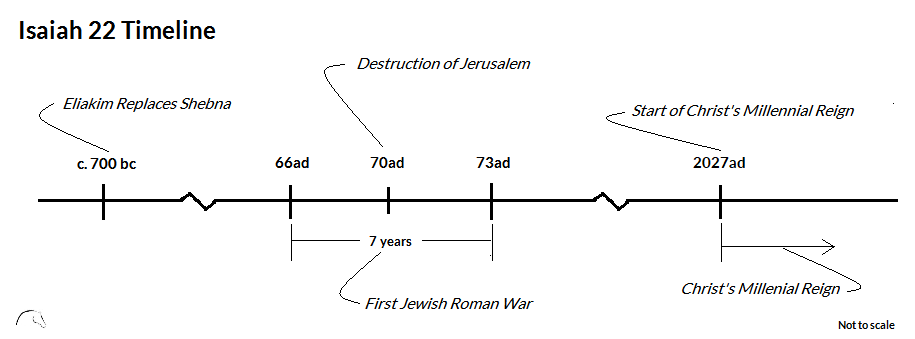
- The time of Eliakim and Shebna of Hezekiah's court (circa 700BC).
- The First Half (66AD–70AD) of the First Jewish–Roman War (66AD–73AD). The Roman army began their siege of Jerusalem in 70 AD and completely destroyed the city and its people shortly thereafter.
- The start of Christ's Millennial Reign on earth (from 2026AD).
2. Parsing the chiasmus
We will use the NIV Bible for this parse.
Parsing this chiasmus involves dividing portions of the text into the three categories above. We will call the time of Eliakim and Shebna Period 1, the siege of Jerusalem in 70 AD Period 2 and the start of Christ's Millennial Reign Period 3.
Categorizing Isaiah 22
Vs 1b-14 belong to Period 2. Although the text does not specify who attacked Jerusalem or when, we take the stand that this is the Roman attack during the First Jewish-Roman war, primarily because we expect to see it in chiastic reconfigurations. Around this time, God asks for repentance and mourning from the Judahites in Jerusalem, but instead they engage in revelry, celebration and mockery. ( It may appear that this prophecy predicts Sennacherib's aborted siege of the city, but vs. 4,5 indicate a great defeat for Jerusalem, something that did not occur at that time.)Vs 15-21a belong to Period 1. Eliakim replaces Shebna as the palace administrator of Jerusalem.
Vs 21b-23 belong to Period 3. The coming Messiah will have the keys to the house of David. This passage may appear to be about Eliakim's promotion to palace administrator of Jerusalem, but the power and honour accorded to the person in this passage seems rather excessive for that position. So we take the stand that this passage is regarding the coming Messiah, who will rule from David's throne as Christ's representative.
Vs 24 belong to Period 1. Eliakim will bring glory to his family.
Ch 25 belongs to Period 2. Jerusalem, the firm peg, will be sheared off, i.e., Jerusalem will be destroyed. Although similar "peg" metaphors are used in the previous verses about the Messiah (vs 23) and Eliakim (vs 24), it cannot be that this verse predicts the Messiah's or Eliakim's deposition. This technique of applying similar metaphors for different Periods is sometimes used in cryptochiastic passages to obscure subunit boundaries.
Original text
We color-code the chiastic units of the original text (NIV) below for easy visual identification using: red for Period 1, blue for Period 2 and green for Period 3. We have retranslated parts of the text.
Isaiah 22 1a A prophecy against the Valley of Vision:
1b What troubles you now, that you have all gone up on the roofs, 2 you town so full of commotion, you city of tumult and revelry? Your slain were not killed by the sword, nor did they die in battle. 3 All your leaders have fled together or have [a] been captured without using the bow. All who are found in you are under siege together; they have fled from afar. [b] 4 Therefore I said, “Turn away from me; let me weep bitterly. Do not try to console me over the destruction of the daughter of my people [c].”
5 The Lord, the Lord Almighty, has a day of tumult and trampling and terror in the Valley of Vision, a day of battering down walls and of crying out to the mountains. 6 Elam takes up the quiver, with her charioteers and horses; Kir uncovers the shield. 7 Your choicest valleys are full of chariots, and horsemen are posted at the city gates.
8 The Lord stripped away the defenses of Judah. You [d] looked in that day to the weapons in the Palace of the Forest. 9 You saw that the walls of the City of David were broken through in many places; you stored up water in the Lower Pool. 10 You counted the buildings in Jerusalem and tore down houses to strengthen the wall. 11 You built a reservoir between the two walls for the water of the Old Pool. You [e] did not look to the One who made it, or have regard for the One who planned it long ago. 12 The Lord, the Lord Almighty, called you on that day to weep and to wail, to tear out your hair and put on sackcloth. 13 But see, there is joy and revelry, slaughtering of cattle and killing of sheep, eating of meat and drinking of wine! “Let us eat and drink,” you say, “for tomorrow we die!”
14 The Lord Almighty has revealed this in my hearing: “Till your dying day this sin will not be atoned for,” says the Lord, the Lord Almighty.
15 This is what the Lord, the Lord Almighty, says: “Go, say to this steward, to Shebna the palace administrator: 16 What are you doing here and who gave you permission to cut out a grave for yourself here, hewing your grave on the height and chiseling your resting place in the rock?
17 Beware, the LORD will cast you down headlong, you mighty man, and he will cover you up [f]. 18 He will roll you up tightly like a ball and throw you into a vast expanse. There you will die alongside the chariots that were your pride, you shame of your master's house. [g] 19 I will depose you from your office, and you will be ousted from your position.
20 “In that day I will summon my servant, Eliakim son of Hilkiah. 21a I will clothe him with your robe and fasten your sash around him and hand your authority over to him.
21b He will be a father to those who live in Jerusalem and to the people of Judah. 22 I will place on his shoulder the key to the house of David. What [h] he opens no one can shut, and what he shuts no one can open. 23 I will drive him like a peg into a firm place. He will become a glorious throne [i] for the house of his father.
24 All the glory of his father's house [j] will hang on him: its offspring and offshoots—all its lesser vessels, from the bowls to all the jars.
25 “In that day,” declares the Lord Almighty, “the peg driven into the firm place will give way; it will be sheared off and will fall, and the load hanging on it will be cut down.” The Lord has spoken.
Retranslation notes for Isaiah 22
[a] vs 3 "or have" instead of "; they have".
[b] vs 3 "All who are found in you are under siege together; they have fled from afar" instead of "All you who were caught were taken prisoner together, having fled while the enemy was still far away".
[c] vs 4 "the daughter of my people" instead of "my people".
[d] vs 8 ". You" instead of ", and you".
[e] vs 11 ". You" instead of ", but you".
[f] vs 17 "Beware, the LORD will cast you down headlong, you mighty man, and he will cover you up" instead of "Beware, the LORD is about to take firm hold of you and hurl you away, you mighty man".
[g] vs 18 "into a vast expanse. There you will die alongside the chariots that were your pride, you shame of your master's house" instead of 'into a large country. There you will die and there the chariots you were so proud of will become a disgrace to your master’s house'.
[h] vs 22 "David. What" instead of "David; what". For the regular chiasmus.
[i] vs 23 ". He will become a glorious throne" instead of "; he will become a seat of honor".
[j] vs 24 "his father's house" instead of "his family".
3. Building the reconfigured text
From this parse, it appears that Isaiah 22 forms a cryptochiasmus as below:A1 Vs 1b-14 Period 2. The Roman attack during the First Jewish-Roman war
B1 Vs 15-21a Period 1. Eliakim replaces Shebna as the palace administrator
X Vs 21b-23 Period 3. The coming Messiah will reign on David's throne
B2 Vs 24 Period 1. Eliakim will bring glory to his family
A2 Vs 25 Period 2. Jerusalem, the firm peg, will be sheared off
We now reconfigure the passages in the right order based on the chiastic structure above and based on the ordering rules of a cryptochiasmus [1].
We lead with central pivot point 'X'. The corresponding subunits (for example, subunit A1 corresponds to A2) are placed contiguously to form units (for example, A1,A2 is a unit) so that we get a list of such units.
The sequence selected for rearrangement is:
X [A1,A2] [B1,B2] (1)
Translating (1) into verse numbers, we get:
Vs 21b-23 [Vs 1b-14, Vs 25] [Vs 15-21a, Vs 24] (2)
We arrive at the reconfigured passage in the next section by rearranging the verses so they are in sequence (2).
4. Isaiah 22 Reconfigured
The Start of Christ's Millennial Reign on Earth (from 2026AD) (Vs 21b-23)The First Half (66AD–70AD) of the First Jewish–Roman War (66AD–73AD) (Vs 1b-14, Vs 25)
Chiasmus 1: The Romans prepare to attack Jerusalem (summer of 70AD) (vs 1b-7)
Chiasmus 2: The Judahites depend on their own preparations instead of looking to God (66-70AD) (vs 8-11)
Chiasmus 3: The Judahites are punished for mocking Christ and for celebrating instead of repenting (66-70AD) (vs 12-14,25)
Eliakim replaces Shebna (circa 700BC) (Vs 15-21a, Vs 24)
5. A Commentary on the Reconfigured Text
5.0 Introductory Statement (vs 1a)
1a A prophecy against the Valley of Vision:
Although Jerusalem sits on elevated land, it is called a "valley" here, because it is "encompassed" by mountains. It is a place of "vision", probably because many prophets were based out of the city. Periods 1 and 3 of this prophecy are regarding the leadership in Jerusalem, and Period 2 predicts the destruction of Jerusalem in 70AD. This introductory line lies outside the cryptochiasmus.
We date the prophecy to the time of Eliakim and Shebna, around 700BC.
5.1 The Start of Christ's Millennial Reign on Earth (from 2026AD) (Vs 21b-23)
This Period is arranged in the form of a two-unit chiasmus:A1 vs 21b The benevolent and glorious reign of the coming Messiah
B1 vs 22a God will establish and uphold the Messiah's reign
X vs 22b The Messiah will have absolute power over the earth (from 2030AD)
B1 vs 23a God will establish and uphold the Messiah's reign
A2 vs 23b The benevolent and glorious reign of the coming Messiah
Subunit A1: The benevolent and glorious reign of the coming Messiah (vs 21b)
21b He will be a father to those who live in Jerusalem and to the people of Judah.
The Messiah will reign over the people of Israel like a benevolent father (he is also called "The Everlasting Father" in Isaiah 9:6). We take Isaiah's nation and capital, "Judah" and "Jerusalem", to represent the New Israel in this Period.
Subunit B1: God will establish and uphold the Messiah's reign (vs 22a)
22a I will place on his shoulder the key to the house of David.
The Messiah, a descendant of David, will be crowned king over Israel in the New Jerusalem (see also Rev. 3:7, Jeremiah 23:5-8). In Isaiah's time, a large physical key was carried on the shoulder as a sign of office, so this passage indicates that God will give the Messiah the power of the royal line of David.
Pivot X: The Messiah will have absolute power over the earth (from 2030AD) (vs 22b)
22b What he opens no one can shut, and what he shuts no one can open.
The coming Messiah will be the ultimate authority and will have final say in all decisions regarding the New Israel, and, as King of Kings, he will also preside over international matters (from 2030AD); however, he will work under the supervision of God and Christ (Rev 2:26,27). We have shown in our parse of Rev 3 [3] that Rev. 3:7, which has language similar to this passage, also applies to the coming Messiah.
Subunit B2: God will establish and uphold the Messiah's reign (vs vs 23a)
23a I will drive him like a peg into a firm place.
The Lord will ensure that the Messiah will remain in his role as King of Israel throughout the Millennial Reign, with the stability and dependability of a peg driven into a firm place (see also Isaiah 9:7).
Subunit A2: The benevolent and glorious reign of the coming Messiah (vs 23b)
23b He will become a glorious throne for the house of his father.
The coming Messiah, who will be of the line of David, will be a glorious king, bringing honour to that royal house of David through his righteous and powerful reign (see also 2 Samuel 7:12-16, Isaiah 11:1-10, Isaiah 9:6,7) - we take the word "throne" in this passage to metonymically mean "king".
5.2 The First Half (66AD–70AD) of the First Jewish–Roman War (66AD–73AD) (Vs 1b-14, Vs 25)
This Period is structured as a series of 3 chiasmi.Chiasmus 1: The Romans prepare to attack Jerusalem (summer of 70AD) (vs 1b-7)
A1 vs 1b-3 Immediately before the attack on the city: The state of the Judahites (summer of 70AD)
X vs 4 Isaiah mourns for the descendants of his people
A2 vs 5-7 Immediately before the attack on the city: The Romans prepare to attack (summer of 70AD)
Subunit A1: Immediately before the attack on the city: The state of the Judahites (summer of 70AD) (vs 1b-3)
This subunit is addressed to the residents of Jerusalem.
1b What troubles you now, that you have all gone up on the roofs, 2a you town so full of commotion, you city of tumult and revelry?
The people of Jerusalem, a city that is usually full of tumult and revelry (see vs 13 below, see also Isaiah 23:7), have gone up to the roofs of their houses; they watch in fear and distress as the Romans prepare to attack the city. ( See our parse of the 70 weeks of Daniel for historical background on this Period [2].)
2b Your slain were not killed by the sword, nor did they die in battle
The Zealots, one of the several factions in Jerusalem, destroyed food reserves in the city in an effort to induce the Judahites to go out and fight the Romans. As a result, many died of starvation during the siege ("not killed by the sword"), even before the Roman slaughter following the breach of the city walls (see also Isaiah 3:1).
3a All your leaders have fled together or have been captured without using the bow.
At the start of the war (fall of 66AD), in order to punish a Judahite revolt, the Roman governor Gessius Florus arrested many of the Judahite leaders during a raid ("without using the bow" indicates that they were not captured in battle), and flogged and crucified them. Also, many of the righteous leaders of the Judahites heeded Christ's advice to flee to the mountains as soon as the Romans arrived in Jerusalem in the spring of 70AD (Matt. 24:15-17). So in this battle for Jerusalem, the city had to defend itself without its seasoned leadership (see Isaiah 3:1-7).
3b All who are found in you are under siege together; they have fled from afar.
During the campaign leading up to the assault on Jerusalem, the Romans attacked the Judahite centres surrounding the capital, and so the Judahites of these regions fled to the fortified city of Jerusalem ("fled from afar"). Those that did not escape immediately on the Roman arrival at Jerusalem were trapped in the city.
Pivot X: Isaiah mourns for the descendants of his people (vs 4)
4 Therefore I said, “Turn away from me; let me weep bitterly. Do not try to console me over the destruction of the daughter of my people.”
Isaiah is stricken with sorrow when sees the great punishment from God that looms for these besieged Judahites, the descendants ("daughter") of his people; he asks that his listeners leave him alone for a while as he grieves (see also Isaiah 21:3-4).
Subunit A2: Immediately before the attack on the city: The Romans prepare to attack (summer of 70AD) (vs 5-7)
5 The Lord, the Lord Almighty, has a day of tumult and trampling and terror in the Valley of Vision, a day of battering down walls and of crying out to the mountains.
The Romans prepare to execute the "Day of the Lord" of this Period. In this "Day of the Lord" (see also Joel 1:14-16), God will use the Romans to massacre His own people and destroy Jerusalem (c. Jul.- Sep. 70AD) as punishment for their many sins, especially that of rejecting Christ. The people of the city will cry in terror and anguish as the Romans break down the walls of the city and viciously attack everyone in it (see also Zephaniah 1:10-12). We take the phrase "crying out to the mountains" to mean that the loud cries of the battle will ring out to the surrounding mountains.
6 Elam takes up the quiver, with her charioteers and horses; Kir uncovers the shield. 7 Your choicest valleys are full of chariots, and horsemen are posted at the city gates.
The Romans "take up the quiver" and "uncover the shield" to prepare for battle. Their presence at the strategically important parts outside the city, the main roads ("choicest valleys") and the city gates, indicates that they are about to attack the city. ( We believe the "valleys" of vs 7 refers to the thoroughfares of Jerusalem that tended to be between the hills in and around the city.)
The warriors of Elam and Kir, expert fighters (see Jeremiah 49:35) that were a part of the Assyrian army, represent the skilled soldiers of this Roman army - Assyria, Satan's kingdom in Isaiah's time, represents Rome, his empire in this period. It is unlikely that the Romans extensively used impractical chariots in the rough terrain and narrow streets in and around Jerusalem, so the military equipment mentioned here represents the potent weaponry of the Roman army.
Chiasmus 2: The Judahites depend on their own preparations instead of looking to God (66-70AD) (vs 8-11)
A1 vs 8 The Judahites prepare to fight instead of seeking God's guidance
X vs 9-11a The Judahites prepare for a siege against Jerusalem
A2 vs 11b The Judahites prepare to fight instead of seeking God's guidance
Subunit A1: The Judahites prepare to fight instead of seeking God's guidance (vs 8)
8 The Lord stripped away the defenses of Judah. You looked in that day to the weapons in the Palace of the Forest.
At the start of the war (66AD), God removed His divine protection over His people (Michael stands by - see Dan 12:1) and made a covenant with the Romans that enabled them to destroy His nation [2].
The Judahites should have repented, turned to Christ, and followed his advice to flee to the mountains (Matt. 24:15-17), but instead they made their own preparations to fight the Romans. They amassed a large quantity of weapons and stored them in the "Palace of the Forest" - an armoury built by Solomon (1 Kings 10:16, 17) that is probably so called for the great quantity of cedar from Lebanon used in its construction.
Pivot X: The Judahites prepare for a siege against Jerusalem (vs 9-11a)
9 You saw that the walls of the City of David were broken through in many places; you stored up water in the Lower Pool. 10 You counted the buildings in Jerusalem and tore down houses to strengthen the wall. 11a You built a reservoir between the two walls for the water of the Old Pool.
The Judahites repaired and strengthened the walls of the city of Jerusalem ("City of David"), tearing down houses for the stones. Leading up to the war they completed the Third Wall, for which Herod Agrippa I had earlier laid the foundation. They built up their stores of water, creating a reservoir inside the city walls for the overflow from the Old Pool / Lower Pool. ( Note the parallelism in vs 9 & vs 10-11a.)
If they had been faithful to God, they would have believed in Christ and fled the city instead of trying to survive a siege (Matt. 24:16-20).
Subunit A2: The Judahites prepare to fight instead of seeking God's guidance (vs 11b)
11b You did not look to the One who made it, or have regard for the One who planned it long ago.
The Judahites foolishly trusted in their own preparations instead of seeking the advice of their God, the One who had given them the land (Joshua 21:43).
Chiasmus 3: The Judahites are punished for mocking Christ and for celebrating instead of repenting (66-70AD) (vs 12-14,25)
A1 vs 12-13a The unrepentant Judahites are punished: The sin
X vs 13b-14 The Judahites are punished for mocking Christ
A2 vs 25 The unrepentant Judahites are punished: The punishment
Subunit A1: The unrepentant Judahites are punished: The sin (12-13a)
12 The Lord, the Lord Almighty, called you on that day to weep and to wail, to tear out your hair and put on sackcloth. 13a But see, there is joy and revelry, slaughtering of cattle and killing of sheep, eating of meat and drinking of wine!
From the time of Christ's ministry up to the fall of Jerusalem, Christ and his followers called on the wicked Judahites to repent and turn from their sins (see Matt 23:33-38). But instead of weeping in remorse for their sins, the wicked Judahites indulged in celebration in their "city of revelry" (see vs 2 above, see also Isaiah 23:7).
Pivot X: The Judahites are punished for mocking Christ (vs 13b-14)
13b “Let us eat and drink,” you say, “for tomorrow we die!” 14 The Lord Almighty has revealed this in my hearing: “Till your dying day this sin will not be atoned for,” says the Lord, the Lord Almighty.
Jesus and his disciples had warned that the Judahites who do not repent will die (see Matt 23:33-38, Luke 13:4-5), but the wicked Judahites mock these warnings ("Let us eat and drink, for tomorrow we die"). They will certainly die, and they cannot atone for this sin by performing sacrifices according to the Old Covenant (see also Isaiah 8:14,15).
Subunit A2: The unrepentant Judahites are punished: The punishment (vs 25)
This subunit continues from the corresponding Subunit A1 above.
25 “In that day,” declares the Lord Almighty, “the peg driven into the firm place will give way; it will be sheared off and will fall, and the load hanging on it will be cut down.” The Lord has spoken.
The well-fortified city of Jerusalem was a strong refuge for the Judahites, like a dependable, firm wall-peg on which things were hung. But the city will be destroyed in the Roman attack ("the peg will be sheared off and will fall"), and its residents will be killed (the "load hanging on it will be cut down").
5.3 Eliakim replaces Shebna (circa 700BC) (Vs 15-21a, Vs 24)
This Period is arranged in the form of a single-unit chiasmus:A1 15-17 Shebna abuses his power, so he is replaced by Eliakim
X 18 Shebna is later exiled
A2 19-21a,24 Shebna abuses his power, so he is replaced by Eliakim
Subunit A1: Shebna abuses his power, so he is replaced by Eliakim (vs 15-17)
15 This is what the Lord, the Lord Almighty, says: “Go, say to this steward, to Shebna the palace administrator: 16 What are you doing here and who gave you permission to cut out a grave for yourself here, hewing your grave on the height and chiseling your resting place in the rock?
Isaiah goes to see Shebna, the palace administrator, as Shebna is setting up a sepulchre for himself in a prominent place ("on the height" and "in the rock"). Apparently Shebna was not entitled to be buried at this location, so Isaiah rebukes him ("who gave you permission?") for this abuse of power towards his own glory.
17 Beware, the LORD will cast you down headlong, you mighty man, and he will cover you up.
For his corrupt behaviour, Shebna will be deposed - he will be cast down and covered up like unsightly garbage. Note that Isaiah's language is designed to show disrespect to this proud man; we propose that the language is particularly harsh because Shebna is a type of the Antichrist (see also Isaiah 14:19).
Pivot X: Shebna is later exiled (vs 18)
18 He will roll you up tightly like a ball and throw you into a vast expanse. There you will die alongside the chariots that were your pride, you shame of your master's house.
Even after Shebna is deposed he continues to work at the palace under Eliakim (see Isaiah 36:3). However, later God will humiliatingly expel Shebna from Judea into the wilderness ("vast expanse" - we assume it is a wilderness because this is a punishment), where he will die alongside his chariots (he must have been sent into exile on his chariots), for his chariots are an expression of his vanity. His unseemly behaviour has brought shame to his master, the good king Hezekiah. Isaiah's language ("roll you up tightly like a ball and throw you") is clearly designed to scorn and humiliate this proud man.
Subunit A2: Shebna abuses his power, so he is replaced by Eliakim (vs 19-21a,24)
This passage continues from the corresponding Subunit A1 above.
19 I will depose you from your office, and you will be ousted from your position. 20 “In that day I will summon my servant, Eliakim son of Hilkiah. 21a I will clothe him with your robe and fasten your sash around him and hand your authority over to him.
God will replace the vain Shebna with Eliakim, his worthy servant, as palace administrator (see also Isaiah 36) - the robe and sash are symbols of his authority as grand vizier.
24 All the glory of his father's house will hang on him: its offspring and offshoots—all its lesser vessels, from the bowls to all the jars.
Others of Eliakim's family, particularly his own descendants, will also enjoy some degree of power and honour through him. Pegs driven into the wall were used to hold household vessels in those times, so the sense of the passage is that Eliakim ("a peg") will support others of his family ("lesser vessels" - those lesser than him), whether they be great ("jars") or small ("bowls").
We believe that this passage describes a type, so that in Period 3, like Eliakim's family, others of David's line will rely on the power and glory of the coming Messiah. ( Note that the "peg" metaphor is used in all three Periods in different contexts.)
Conclusion
With this chiastic reconfiguration of the text, we have shown that Isaiah 22 contains prophecies on three distinct Periods.
The first Period of this reconfiguration is about Eliakim replacing Shebna as palace administrator. This is a relatively minor incident compared to the typical prophecies in cryptochiasmi, but we propose that this event is a type of the start of the Messiah's reign. Just as the vain Shebna was replaced by Eliakim, so also the wicked Antichrist will be replaced by a righteous Messiah.
References
[1] A Definition of Cryptochiasmus[2] A Chiastic Reconfiguration Of "The 70 Weeks Of Daniel"
[3] A Reconfiguration of Revelation 2 and 3
[4] A Chiastic Reconfiguration Of Daniel 8
[5] A Chiastic Reconfiguration Of Zechariah 12-14
* First version published on 10 March 2020.