
A Chiastic Reconfiguration Of Joel
Kuruvilla Thomas
Bangalore
Published on 1 August 2026 *
Introduction
This study treats Joel as a cryptochiasmus in order to arrive at a coherent reconfiguration of the text ( see definition of cryptochiasmus in [1] ). If you wish to skip the technicalities of a chiastic parse, you may read starting from Section 4 of the Discussion section, which has the reconfigured text.
We will show that this prophecy in the book of Joel, which appears to be about a swarm of locusts in Joel 1 & 2, is regarding 4 different types of attacks that occur in 3 distinct Periods. This book specifies the three "Days of the Lord" that are mentioned in several other prophecies.
Discussion
1. Presuppositions
We base our parse of Joel on the assumption that it refers to 3 periods:
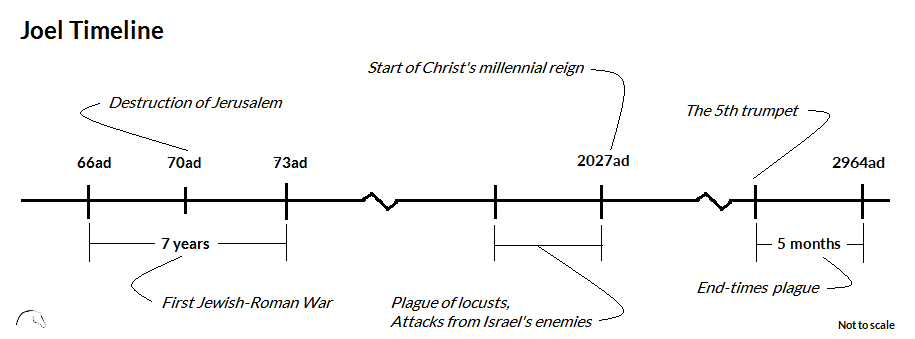
- The First Half (66AD-70AD) of The First Jewish–Roman War (66AD–73AD). The Roman army executes a ruthless campaign of devastation against Judea before attacking Jerusalem.
- Israel's enemies are defeated at the start of Christ's Millennial Reign (from 2026AD). God defeats Israel's enemies, the nation is restored after attacks by locusts.
- The Fifth Trumpet of the End-Times Tribulation (c. 2964AD). At the 5th trumpet, creatures from the Abyss afflict the wicked of the earth.
2. Parsing the chiasmus
We will use the NIV Bible for this parse.
Parsing this chiasmus involves dividing portions of the text into the three categories above. We will call the period of The First Jewish–Roman War Period 1, The Start of Christ's Millennial Reign Period 2 and the End-Times Tribulation Period 3.
Categorizing Joel
Ch 1 Vs 2-7 belong to Period 2. In the land of the Israelites, great locust swarms destroy all vegetation in their path at the start of Christ's Millennial Reign.Ch 1 Vs 8 - Ch 2 Vs 3 belong to Period 1. The Romans destroy the crops and end sacrifices at Jerusalem. The priests in Judea lament this cessation of sacrifices. Although this section appears to be an extension of the tale of loss inflicted by the locusts, the character of the damage here is different - for instance, locusts do not destroy granaries. We propose that vs 1:8 is a part of this subunit, because the destruction by locusts, while serious, does not call for the great lament of a young bride grieving for her husband. We treat 2:3, the closing boundary, as a part of this subunit, because it mentions the Romans' destruction of the vegetation by fire - the creatures of Period 3 (the next subunit) do not harm vegetation (see Rev. 9:4).
Ch 2 Vs 4-14 belong to Period 3. While this passage can also be interpreted as a locust attack, some of the characteristics of this swarm indicate otherwise; for example, this swarm storms cities instead of fields. We believe they are the creatures of the 5th trumpet of the End-Times Tribulation (Rev. 9:1-11) that torture people but do not harm vegetation [6]. Joel attempts to describe the creatures - they look like horses, etc. - something that would be unnecessary if they were the ordinary locusts his audience knew well.
Ch 2 Vs 15-17 belongs to Period 1. The people of Judah fast and pray, seeking God's mercy. ( The last verses of the previous subunit, 2:12-14, may appear to be regarding this Period because of the mention of grain and drink offerings, but we treat those verses as figurative - see commentary below. After the death of Christ, these offerings are no longer required of the people of Judah.)
Ch 2 Vs 18-27 belong to Period 2. At the start of Christ's reign, God takes control of the earth and makes His people prosperous. He defeats the Beast army that attacks the New Israel from the north. He remedies the destruction wrought by the locusts. His people will never again be shamed.
Ch 2 Vs 28-32 belong to Period 1. This passage is quoted in Acts 2:17-21 as being about the time after Jesus' First Coming. Christian Judahites were given the gift of prophecy through the Holy Spirit. They escaped the Roman massacre.
Ch 3 belongs to Period 2. The Beast army and its allies are defeated and punished. Christ begins his reign over a prosperous Israel.
Original text
We color-code the chiastic units of the original text (NIV) below for easy visual identification using: red for Period 1, blue for Period 2 and green for Period 3. We have retranslated parts of the text.
Joel 1 2 Hear this, you elders; listen, all who live in the land. Has anything like this ever happened in your days or in the days of your ancestors? 3 Tell it to your children, and let your children tell it to their children, and their children to the next generation. 4 What the locust swarm has left the great locusts have eaten; what the great locusts have left the young locusts have eaten; what the young locusts have left other locusts have eaten.
5 Wake up, you drunkards, and weep! Wail, all you drinkers of wine; wail because of the new wine, for it has been snatched from your lips. 6 A nation has invaded my land, a mighty army without number; it has the teeth of a lion, the fangs of a lioness. 7 It has laid waste my vines and ruined my fig trees. It has stripped off their bark and thrown it away, leaving their branches white.
8 Mourn like a virgin in sackcloth grieving for the betrothed of her youth. 9 Grain offerings and drink offerings are cut off from the house of the Lord. The priests are in mourning, those who minister before the Lord. 10 The fields are ruined, the ground is dried up; the grain is destroyed, the new wine is dried up, the olive oil fails.
11 Despair, you farmers, wail, you vine growers; grieve for the wheat and the barley, because the harvest of the field is destroyed. 12 The vine is dried up and the fig tree is withered, also the pomegranate, the palm and the apple tree. All the trees of the field are dried up, because joy is withdrawn from the people. [a]
13 Put on sackcloth, you priests, and mourn; wail, you who minister before the altar. Come, spend the night in sackcloth, you who minister before my God; for the grain offerings and drink offerings are withheld from the house of your God. 14 Declare a holy fast; call a sacred assembly. Summon the elders and all who live in the land to the house of the Lord your God, and cry out to the Lord.
15 Alas for that day! For the day of the Lord is near; it will come like destruction from the Almighty.
16 Has not the food been cut off before our very eyes— joy and gladness from the house of our God? 17 The seeds are shriveled beneath the clods. The storehouses are in ruins, the granaries have been broken down, indeed [b] the grain has dried up. 18 How the cattle moan! The herds mill about because they have no pasture; even the flocks of sheep are suffering.
19 To you, Lord, I call, for fire has devoured the open pastures [c] and flames have burned up all the trees of the field. 20 Even the wild animals pant for you; the streams of water have dried up and fire has devoured the open pastures [d].
Retranslation notes for Joel 1
[a] vs 12 "withered, also the pomegranate, the palm and the apple tree. All the trees of the field are dried up, because joy is withdrawn from the people" instead of "withered; the pomegranate, the palm and the apple tree— all the trees of the field—are dried up. Surely the people’s joy is withered away". Based on the Douay-Rheims Bible.
[b] vs 17 "indeed" instead of "for".
[c] vs 19 "open pastures" instead of "pastures in the wilderness".
[d] vs 20 "open pastures" instead of "pastures in the wilderness".
Joel 2 1 Blow the trumpet in Zion; sound the alarm on my holy hill. Let all who live in the land tremble, for the day of the Lord is coming. It is close at hand— 2 a day of darkness and gloom, a day of clouds and blackness. Like dawn spreading across the mountains a large and mighty nation [a] comes, such as never was in ancient times nor ever will be in ages to come.
3 Before them fire devours, behind them a flame blazes. Before them the land is like the garden of Eden, behind them, a desert waste— nothing escapes them.
4 They have the appearance of horses; they gallop along like cavalry. 5 With a noise like that of chariots they leap over the mountaintops, with a sound like a crackling fire consuming stubble, they are as a mighty army deployed for battle. [b]
6 Before them the peoples are in anguish, every face is contorted. [c] 7 They charge like warriors; they scale walls like soldiers. They all march in line, not swerving from their course. 8 They do not jostle each other; each marches straight ahead. They plunge through defenses without breaking ranks. 9 They rush upon the city; they run along the wall. They climb into the houses; like thieves they enter through the windows.
10 Before them the earth shakes, the heavens tremble, the sun and moon are darkened, and the stars no longer shine. 11 The Lord thunders at the head of his army; his forces are beyond number, and mighty is the one [d] that obeys his command. The day of the Lord is great; it is dreadful. Who can endure it?
12 “Even now,” declares the Lord, “return to me with all your heart, with fasting and weeping and mourning.”
13 Rend your heart and not your garments. Return to the Lord your God, for he is gracious and compassionate, slow to anger and abounding in love, and he relents from doing harm [e]. 14 Who knows? It may turn and repent and leave behind a gift [f] — grain offerings and drink offerings for the Lord your God.
15 Blow the trumpet in Zion, declare a holy fast, call a sacred assembly. 16 Gather the people, consecrate the assembly; bring together the elders, gather the children, those nursing at the breast. Let the bridegroom leave his room and the bride her chamber. 17 Let the priests, who minister before the Lord, weep between the portico and the altar. Let them say, “Spare your people, Lord. Do not make your inheritance an object of scorn, one that is ruled by other nations [g]. Why should they say among the peoples, ‘Where is their God?’”
18 The Lord was zealous [h] for his land and took pity on his people.
19 The Lord announced [i] to them:
“I am sending you grain, new wine and olive oil, enough to satisfy you fully; never again will I make you an object of scorn to the nations."
20 "I will drive the armies from the north away from you. I will drive it into a barren and desolate land, with its front at the eastern river, and its rear at the western river. Its stench will rise, its foul odour will ascend, for it has done monstrous things.” [j] 21 Do not be distressed, O land; be glad and rejoice, for [k] the Lord has done great things! 22 Do not be distressed [l], you wild animals, for the pastures in the wilderness are becoming green. The trees are bearing their fruit; the fig tree and the vine yield their riches.
23 Be glad, people of Zion, rejoice in the Lord your God, for he has given you the teacher unto righteousness, and he sends you abundant showers, both the early and the latter rain, as before. [m] 24 The threshing floors will be filled with grain; the vats will overflow with new wine and oil. 25 “I will repay you for the years the locusts have eaten— the great locust and the young locust, the other locusts and the locust swarm— my great army that I sent among you. 26 You will have plenty to eat, until you are full. You [n] will praise the name of the Lord your God, who has worked wonders for you; never again will my people be shamed. 27 You [o] will know that I am in Israel, that I am the Lord your God, and that there is no other; never again will my people be shamed.
28 “And afterward, I will pour out my Spirit on all people. Your sons and daughters will prophesy, your old men will dream dreams, your young men will see visions. 29 Even on my servants, both men and women, I will pour out my Spirit in those days. 30 I will show signs in the sky and on the earth—blood [p] and fire and billows of smoke. 31 The sun will be turned to darkness and the moon to blood before the coming of the great and dreadful day of the Lord. 32 And everyone who calls on the name of the Lord will be saved;
for on Mount Zion and in Jerusalem there will be deliverance, as the Lord has said; the remnant will be those whom the LORD calls [q].
Retranslation notes for Joel 2
[a] vs 2 "nation" instead of "army".
[b] vs 5 "with a sound like a crackling fire consuming stubble, they are as a mighty army deployed for battle" instead of "like a crackling fire consuming stubble, like a mighty army drawn up for battle".
[c] vs 6 "Before them the peoples are in anguish, every face is contorted" instead of "At the sight of them, nations are in anguish; every face turns pale".
[d] vs 11 "one" instead of "army".
[e] vs 13 "doing harm" instead of "sending calamity".
[f] vs 14 "It may turn and repent and leave behind a gift" instead of "He may turn and relent and leave behind a blessing".
[g] vs 17 "one that is ruled by other nations" instead of "a byword among the nations".
[h] vs 18 "zealous" instead of "jealous".
[i] vs 19 "announced" instead of "replied".
[j] vs 20 "I will drive the armies from the north away from you. I will drive it into a barren and desolate land, with its front at the eastern river, and its rear at the western river. Its stench will rise, its foul odour will ascend, for it has done monstrous things." instead of 'I will drive the northern horde far from you, pushing it into a parched and barren land; its eastern ranks will drown in the Dead Sea and its western ranks in the Mediterranean Sea. And its stench will go up; its smell will rise." Surely he has done great things!'.
[k] vs 21 "Do not be distressed, O land; be glad and rejoice, for" instead of "Do not be afraid, land of Judah; be glad and rejoice. Surely".
[l] vs 22 "distressed" instead of "afraid".
[m] vs 23 "the teacher unto righteousness, and he sends you abundant showers, both the early and the latter rain, as before" instead of "the autumn rains because he is faithful. He sends you abundant showers, both autumn and spring rains, as before".
[n] vs 26 "full. You" instead of "full, and you". For the chiasmus.
[o] vs 27 "You" instead of "Then you".
[p] vs 30 "signs in the sky and on the earth—blood" instead of "wonders in the heavens and on the earth, blood".
[q] vs 32 "said; the remnant will be those whom the LORD calls" instead of "said, even among the survivors whom the LORD calls".
Joel 3 “In those days and at that time, when I restore the fortunes of Judah and Jerusalem, 2 I will gather all nations and bring them down to the Valley of Jehoshaphat. At that time, I will bring charges against them [a] for what they did to my inheritance, my people Israel, because they scattered my people among the nations and divided up the people of my land [b]. 3 They cast lots for my people and traded boys for prostitutes; they sold girls for wine to drink.
4 “Now what have you against me, Tyre and Sidon and all you regions of Philistia? Are you repaying me for something I have done? If you are paying me back, I will swiftly and speedily return on your own heads what you have done. 5 For you took my silver and my gold and carried off my finest treasures to your temples. 6 You sold the people of Judah and Jerusalem to the Javans, that you might send them away from their homes [c].
7 “See, I am going to rouse them out of the places to which you sold them, and I will return on your own heads what you have done. 8 Your sons and daughters will be sold to the people of Judah; they will be sold to the Sabeans, a nation out of reach [d].” The Lord has spoken.
9 Proclaim this among the nations: Prepare for war! Rouse the warriors! Let all the fighting men draw near and attack. 10 Beat your plowshares into swords and your pruning hooks into spears. Let the weakling say, “I am strong!” 11 Come quickly, all you nations from every side, and assemble there.
Bring down your warriors, Lord!
12 “Let the nations be roused; let them advance into the Valley of Jehoshaphat, for there I will sit to judge all the nations on every side. 13 Swing the sickle, for the harvest is ripe. Come, trample the grapes, for the winepress is full and the vats overflow— so great is their wickedness!”
14 Multitudes, multitudes in the valley of decision! Truly, [e] the day of the Lord is near in the valley of decision. 15 The sun and moon will be darkened, and the stars no longer shine. 16 The Lord will roar from Zion and thunder from Jerusalem; the earth and the heavens will tremble. But the Lord will be a refuge for his people, a stronghold for the people of Israel.
17 “You [f] will know that I, the Lord your God, dwell in Zion, my holy hill. Jerusalem will be holy; never again will foreigners invade her.
18 “In that day the mountains will drip new wine, and the hills will flow with milk. All [g] the ravines of Judah will run with water. A fountain will flow out of the Lord’s house and will water the wadi [h] of acacias. 19 But Egypt will be a wasteland, Edom a desolate wilderness. [i] Because of the violence against the people of Judah, innocent blood has been shed in the land [j]. 20 But Judah [k] will be inhabited forever and Jerusalem through all generations. 21 I will cleanse their guilt which I have not yet cleansed, For the LORD dwells in Zion.[l]
Retranslation notes for Joel 3
[a] vs 2 "At that time, I will bring charges against them" instead of "There I will put them on trial".
[b] vs 2 "the people of my land" instead of "my land".
[c] vs 6 "Javans, that you might send them away from their homes" instead of "Greeks, that you might send them far from their homeland".
[d] vs 8 "Your sons and daughters will be sold to the people of Judah; they will be sold to the Sabeans, a nation out of reach" instead of "I will sell your sons and daughters to the people of Judah, and they will sell them to the Sabeans, a nation far away".
[e] vs 14 "Truly," instead of "For". For the regular chiasmus.
[f] vs 17 "You" instead of "Then you". For the regular chiasmus.
[g] vs 18 "milk. All" instead of "milk; all". For the regular chiasmus.
[h] vs 18 "wadi" instead of "valley".
[i] vs 19 "But Egypt will be a wasteland, Edom a desolate wilderness." instead of "But Egypt will be desolate, Edom a desert waste,".
[j] vs 19 "Because of the violence against the people of Judah, innocent blood has been shed in the land" instead of "because of violence done to the people of Judah, in whose land they shed innocent blood".
[k] vs 20 "But Judah" instead of "Judah".
[l] vs 21 "I will cleanse their guilt which I have not yet cleansed, For the LORD dwells in Zion." instead of 'Shall I leave their innocent blood unavenged? No, I will not.” The LORD dwells in Zion!'. Based on the NASB.
3. Building the reconfigured text
From this parse, it appears that Joel 1-3 form a cryptochiasmus as below:A1 Ch 1 Vs 2-7 Period 2. Locust swarms destroy the vegetation
B1 Ch 1 Vs 8 - Ch 2 Vs 3 Period 1. The Romans devastate Judea and Jerusalem
X Ch 2 Vs 4-14 Period 3. End-Times pestilence
B2 Ch 2 Vs 15-17 Period 1. Judah seeks God's mercy
A2 Ch 2 Vs 18-27 Period 2. The land that was destroyed by the locusts is restored
We now reconfigure the passages in the right order based on the chiastic structure above and based on the ordering rules of a cryptochiasmus [1].
We usually lead with the pivot point but in this case, we place the central pivot point 'X' at the end, as allowed by the rules of cryptochiasmi [1] . The corresponding subunits (for example, subunit A1 corresponds to A2) are placed contiguously to form units (for example, A1,A2 is a unit ) so that we get a list of such units.
The sequence selected for rearrangement is:
[A1,A2] [B1,B2] X (1)
We have the following sequence when we include the rest of the prophecy:
[A1,A2] - Period 2
[B1,B2] - Period 1
X - Period 3
Ch 2 Vs 28-32 - Period 1. Signs and wonders before the destruction of Jerusalem
Ch 3 - Period 2. The Beast alliance is defeated and destroyed
We still have text for the periods in a non-contiguous form. We treat this as a doubly applied cryptochiasmus as below.
M1 [A1,A2] - Period 2
N1 [B1,B2] - Period 1
XX X- Period 3
N2 Ch 2 Vs 28-32 - Period 1
M2 Ch 3 - Period 2
The sequence selected for rearrangement is:
XX [M1,M2] [N1,N2] (2)
Translating this sequence (2) into the subunits of the first chiasmus, we get:
X, [[A1,A2] , Ch 3] [[B1,B2], Ch 2 Vs 28-32] (3)
Further translating (3) into verse numbers, we get:
[Ch 2 Vs 4-14] [[Ch 1 Vs 2-7, Ch 2 Vs 18-27], Ch 3] [[Ch 1 Vs 8 - Ch 2 Vs 3, Ch 2 Vs 15-17], Ch 2 Vs 28-32] (4)
We arrive at the reconfigured passage in the next section by rearranging the verses so they are in sequence (4).
4. Joel Reconfigured
The Fifth Trumpet of the End-Times Tribulation (c. 2964AD) (Ch 2 Vs 4-14)Chiasmus 1: The creatures from the Abyss bring agony to the people of earth (2:4-8)
Chiasmus 2: The Lord sends creatures from the Abyss to reform the wicked of earth (2:9-14)
Israel's enemies are defeated at the start of Christ's Millennial Reign (from 2026AD) (Ch 1 Vs 2-7, Ch 2 Vs 18-27, Ch 3)
Chiasmus 1: The great plague of locusts (1:2-7, 2:18-19)
Chiasmus 2: Israel is restored and its enemies are defeated (2:20-27)
Chiasmus 3: Satan's organizations, "Phoenicia & Philistia" and the Beast, are gathered in Israel for punishment (2030AD) (3:1-10)
Chiasmus 4: The Beast army is destroyed at the borders of the New Israel (2030AD) (3:11-16)
Chiasmus 5: The Lord will preserve and bless His holy nation (3:17-21)
The First Half (66AD-70AD) of The First Jewish–Roman War (66AD–73AD) (Ch 1 Vs 8 - Ch 2 Vs 3, Ch 2 Vs 15-17, Ch 2 Vs 28-32)
Chiasmus 1: The Judahites mourn because of a famine and drought (1:8-13)
Chiasmus 2: The Judahites pray for mercy, for their land is devastated (1:14-20)
Chiasmus 3: The rampaging Romans approach Jerusalem (2:1-3, 2:15-16)
Chiasmus 4: The Judahites who turn to Christ are saved (2:17, 2:28-32)
5. A Commentary on the Reconfigured Text
5.0 Introductory verse
Chapter 1 1 The word of the LORD that came to Joel son of Pethuel.
The name "Joel" means "Yehovah is God" or "one to whom YHWH is God". Joel was from the southern nation of Judah and he was the son of Pethuel, but not much else is known about the prophet, not even the dates of his ministry.
5.1 The Fifth Trumpet of the End-Times Tribulation (c. 2964AD) (Ch 2 Vs 4-14)
The creatures of this Period are those loosed at the 5th trumpet (the 1st Woe) during the End-Times Tribulation (see Rev. 9:1-11 [6]). These infernal creatures from the Abyss, or Bottomless Pit, appear to be spiritual beings that take on a physical form, and they are sent by God to torture the wicked humans remaining on earth (Rev. 9:2-3) (by this time, the faithful either have been raptured out or are protected by the seal of God - Rev. 7). Although many of the characteristics of this swarm are similar to those of locusts, some features do not fit those insects, for instance: these creatures march in line like soldiers, and they attack cities and people and not fields (note that in Rev. 9:4, the creatures are ordered not to harm vegetation).
This Period is structured as a series of 2 chiasmi.
Chiasmus 1: The creatures from the Abyss bring agony to the people of earth (2:4-8)
A1 2:4-5 The army of creatures attacks: It marches towards cities
X 2:6 The creatures from the Abyss bring anguish to the people of earth
A2 2:7-8 The army of creatures attacks: It breaches the cities' defences
Subunit A1: The army of creatures attacks: It marches towards cities (2:4-5)
Chapter 2 4 They have the appearance of horses; they gallop along like cavalry. 5 With a noise like that of chariots they leap over the mountaintops, with a sound like a crackling fire consuming stubble, they are as a mighty army deployed for battle.
As they march to attack the cities of the world, these creatures from the Abyss are like a mighty army. They look and move like horses (Rev. 9:7) and they effortlessly cross mountains. They are noisy; they make harsh, mechanical sounds ("like chariots", "like crackling fire"), as opposed to the more organic buzzing of locusts (Rev. 9:9).
Pivot X: The creatures bring anguish to the people of earth (2:6)
Chapter 2 6 Before them the peoples are in anguish, every face is contorted.
The creatures induce intense pain in the people of earth. Over a period of 5 months, they cause so much pain that the people long to die, but do not (we take "Before them" to mean "Because of them") (see Rev 9:5,6,10).
Subunit A2: The army of creatures attacks: It breaches the cities' defences (2:7-8)
Chapter 2 7 They charge like warriors; they scale walls like soldiers. They all march in line, not swerving from their course. 8 They do not jostle each other; each marches straight ahead. They plunge through defenses without breaking ranks.
When these creatures arrive at a city, they effortlessly breach its defences, like a well-trained army ("charge like warriors", "scale walls like soldiers"). They are terrifyingly persistent and disciplined, remaining in formation even as they plunge through defences; they are like a dystopian army that cannot be stopped.
Chiasmus 2: The Lord sends creatures from the Abyss to reform the wicked of earth (2:9-14)
A1 2:9 The army attacks homes
B1 2:10-11a God sends this army
X 2:11b The great tribulation of the "Day of the Lord"
B2 2:12-13 God sends this army: to reform the wicked
A2 2:14 The army attacks homes: some of them reform
We propose that this chiasmus is read from the middle, in the sequence: [X], [B1,B2], [A1,A2].
Subunit A1: The army attacks homes (2:9)
Chapter 2 9 They rush upon the city; they run along the wall. They climb into the houses; like thieves they enter through the windows.
After they breach the defences of a city (see Chiasmus 1 above), these creatures enter all the houses in the city to torment the people in them (see Rev 9:4,5,10).
Subunit B1: God sends this army (2:10-11a)
Chapter 2 10 Before them the earth shakes, the heavens tremble, the sun and moon are darkened, and the stars no longer shine.
This plague from the Abyss is a worldwide event (see Rev 9:2,3), for this great army simultaneously marches across the earth, shaking the ground as they march (we take "Before them" to mean "Because of them"). The creatures also blanket the sky like locusts, so that the sky appears to tremble, and so that they block the light from heavenly bodies ("sun and moon are darkened..."). ( Typically, the "sun, moon, stars and heavens" together represent the fallen angels that control the nations of the world, but the fallen angels had already lost their power at the beginning of the End-Time Tribulation - see Rev 6:12-14. So here we treat the "sun, moon, stars" as literal heavenly bodies.)
Chapter 2 11a The Lord thunders at the head of his army; his forces are beyond number, and mighty is the one that obeys his command.
It is God that calls out this mighty army to torment the wicked of the earth, so that they may be reformed (see corresponding Subunit A2 below). The army is led by God's powerful angel Abaddon/Apollyon (the "mighty one") (see Rev. 9:11).
Pivot X: The great tribulation of the "Day of the Lord" (2:11b)
Chapter 2 11b The day of the Lord is great; it is dreadful. Who can endure it?
The "Day of the Lord" of this Period refers to the dreadful time of the great End-Times Tribulation from God, the period between the rapture and the judgement [6] (see also 1:15 and 3:14 for the other two "Days of the Lord"). This torment from the creatures of the Abyss is a part of this period of tribulation.
Subunit B2: God sends this army: to reform the wicked (2:12-13)
Chapter 2 12 “Even now,” declares the Lord, “return to me with all your heart, with fasting and weeping and mourning.” 13 Rend your heart and not your garments. Return to the Lord your God, for he is gracious and compassionate, slow to anger and abounding in love, and he relents from doing harm.
Even at this late date, after the Rapture and near the End of the World, God, in His great love, sends this tribulation to reform the remaining wicked of the earth - He is willing to forgive and deliver those who sincerely repent (cf. Rev. 9:20,21). The people of earth may tear their garments from the pain inflicted by these creatures from the Abyss, but if they repent instead ("rend their heart"), they will be spared further harm.
Subunit A2: The army attacks homes: some of them reform (2:14)
Chapter 2 14 Who knows? It may turn and repent and leave behind a gift— grain offerings and drink offerings for the Lord your God.
The prophet speculates that some of the homes of the wicked that are attacked may turn from their sins and repent (we take "It" in this passage to refer to the home that is attacked in 2:9 in the corresponding Subunit A1 above). Those that turn to God and remain faithful through this time of tribulation are gifts to God; repentant sinners are compared to grain and drink offerings - offerings that are pleasing to God (note that the 144,000 of Revelation are similarly considered firstfruit offerings to God - Rev 14:4).
5.2 Israel's enemies are defeated at the start of Christ's Millennial Reign (from 2026AD) (Ch 1 Vs 2-7, Ch 2 Vs 18-27, Ch 3)
This Period is structured as a series of 5 chiasmi.We take "Judah", "Zion, "Jerusalem" (the prophets land and capital) and "Israel" to refer to all of Israel in this Period.
Chiasmus 1: The great plague of locusts (1:2-7, 2:18-19)
A1 1:2-3 Prologue: This story will be passed on through generations
B1 1:4 Waves of locusts attack the Israelites
X 1:5 The Israelites are reformed through this plague
B2 1:6-7 Waves of locusts attack the Israelites
A2 2:18-19 Epilogue: God restores the land and blesses it for generations
Subunit A1: Prologue: This story will be passed on through generations (1:2-3)
Chapter 1 2 Hear this, you elders; listen, all who live in the land. Has anything like this ever happened in your days or in the days of your ancestors? 3 Tell it to your children, and let your children tell it to their children, and their children to the next generation.
The Israelites are instructed to listen to this account of devastating waves of locust attacks (of Unit B below) and pass it on to succeeding generations (cf. Psalm 78:5-7).
Subunit B1: Waves of locusts attack the Israelites (1:4)
Chapter 1 4 What the locust swarm has left the great locusts have eaten; what the great locusts have left the young locusts have eaten; what the young locusts have left other locusts have eaten.
Extraordinarily large swarms of locusts devastate the land of the Israelites at the start of the Millennial Reign, with each succeeding generation of locust devouring whatever remains from the previous attack. ( Note the parallel poetic structure - the generations of people of subunit A1 above pass on the story of the generations of locusts of this subunit.)
Pivot X: The Israelites are reformed through this plague (1:5)
Chapter 1 5 Wake up, you drunkards, and weep! Wail, all you drinkers of wine; wail because of the new wine, for it has been snatched from your lips.
The people of Israel, represented here by the drunkards, are informed of the destruction of their crops by a locust attack. The destruction of vines in this passage represents the destruction of all the crops of the land.
We propose that the drunkards are specifically mentioned, because God uses this plague to help the Israelites wake up from their spiritual drunkenness (God Himself had cursed them with spiritual drunkenness millennia ago - see Isaiah 29:9) - they will now stop worshipping pagan gods and return to their God.
Subunit B2: Waves of locusts attack the Israelites (1:6-7)
Chapter 1 6 A nation has invaded my land, a mighty army without number; it has the teeth of a lion, the fangs of a lioness. 7 It has laid waste my vines and ruined my fig trees. It has stripped off their bark and thrown it away, leaving their branches white.
Along with the crops, all the vegetation of the land is ruined by the locust swarms ("nation", "mighty army"). With its strong teeth, the locusts even strip the barks of plants and trees.
Subunit A2: Epilogue: God restores the land and blesses it for generations (2:18-19)
Chapter 2 18 The Lord was zealous for his land and took pity on his people.
19 The Lord announced to them: “I am sending you grain, new wine and olive oil, enough to satisfy you fully; never again will I make you an object of scorn to the nations."
God restores the Israelites to prosperity after the devastating locust attack. The New Israel will remain prosperous and blessed throughout the Millennial Reign, and it will never suffer such calamities again (see also Jer. 31:12).
Chiasmus 2: Israel is restored and its enemies are defeated (2:20-27)
A1 2:20 The Beast army is defeated (2030AD)
B1 2:21-22 Israel is materially restored
X 2:23 Israel is spiritually restored
B2 2:24-26a Israel is materially restored
A2 2:26b-27 The Beast army is defeated: the Israelites turn to God (2030AD)
Subunit A1: The Beast army is defeated (2030AD) (2:20)
Chapter 2 20a "I will drive the armies from the north away from you. I will drive it into a barren and desolate land, with its front at the eastern river, and its rear at the western river.
Shortly after the reign of the Beast of Rev 13 (Nov 2026 - April 2030), God lures its huge army into an assault on the New Israel (Ezekiel 39:2) - this is the Gog and Magog war of Ezekiel 39 (see also Rev 19:17-21, 14:14-20, Joel 3:1-2a). The army crosses the northern border of the New Israel and pushes into the land, but God repels it and forces it to flee ("I will drive the armies from the north away from you").
We believe that this assault will take place over the Karakoram highway, or National Highway 35 (N-35), that connects China to Kashmir (see our commentary on Ezekiel 39 [8]). The front of this fleeing army, when it is destroyed, will be at the "eastern river", which we take to be the Khunjerab River at the Khunjerab Pass on the northern border of Kashmir. The back of the army will be at the "western river", which we believe is the Indus River that meets the highway at the "Three Mountain Ranges And Two Rivers Junction" at Jaglot in Kashmir (see also commentary on Eze. 39:11 in [8]). This stretch of highway runs through a cold, dangerous, inhospitable, desert region ("barren and desolate land"); the distance between the "Three Mountain Ranges And Two Rivers Junction" and the Khunjerab check post along this highway is around 300 kilometres (the distance specified in Rev 14:20).
Chapter 2 20b Its stench will rise, its foul odour will ascend, for it has done monstrous things.”
God miraculously defeats this army and kills all its soldiers suddenly (Ezekiel 39:3, Rev 14:19-20). The corpses remain unburied for a while (Ezekiel 39:4-5), and later the bodies are thrown into an open pit, resulting in an intense stench in the region (this stink is also implied in Eze. 39:11 [8], cf. Rev. 14:20). So this mighty army, that once tyrannically ruled the world and intensely tormented and killed the righteous around the word ("done monstrous things"), comes to an humiliating end.
Subunit B1: Israel is materially restored (2:21-22)
Chapter 2 21 Do not be distressed, O land; be glad and rejoice, for the Lord has done great things! 22 Do not be distressed, you wild animals, for the pastures in the wilderness are becoming green. The trees are bearing their fruit; the fig tree and the vine yield their riches.
After the devastating locust attack (see Chiasmus 1 above and the corresponding Subunit B2 below), God restores the land of the New Israel.
Pivot X: Israel is spiritually restored (2:23)
Chapter 2 23 Be glad, people of Zion, rejoice in the Lord your God, for he has given you the teacher unto righteousness, and he sends you abundant showers, both the early and the latter rain, as before.
The Israelites ("people of Zion") are to rejoice, for God has sent them the Messiah to teach them to live righteously ("teacher unto righteousness") (see also John 14:26, John 16:7-13). The Messiah will pass on abundant spiritual wisdom from God ("abundant showers, both the early and the latter rain"), as prophets like Moses have done in the past ("as before") (see also Isaiah 35:5-7).
Subunit B2: Israel is materially restored (2:24-26a)
Chapter 2 24 The threshing floors will be filled with grain; the vats will overflow with new wine and oil. 25 “I will repay you for the years the locusts have eaten— the great locust and the young locust, the other locusts and the locust swarm— my great army that I sent among you. 26a You will have plenty to eat, until you are full.
The locusts had destroyed years worth of work by the Israelites, but God restores the land so that the vegetation and crops flourish once more; the Israelites enjoy a bountiful harvest and a flourishing economy. Note that, like the creatures from the Abyss in Period 3, this army of locusts is also sent by God ("my great army that I sent among you").
Subunit A2: The Beast army is defeated: the Israelites turn to God (2030AD) (2:26b-27)
Chapter 2 26b You will praise the name of the Lord your God, who has worked wonders for you; never again will my people be shamed. 27 You will know that I am in Israel, that I am the Lord your God, and that there is no other; never again will my people be shamed.
When God defeats the Beast army, the Israelites will see the power of their God, the One True God, and they will remain faithful to Him throughout the Millennial Reign (see also, for instance, Micah 5:12-14). So they will never again be brought low by Satan's forces and be the object of scorn ("shamed") (see also, for example, Zeph. 3:9-20).
Chiasmus 3: Satan's organizations, "Phoenicia & Philistia" and the Beast, are gathered in Israel for punishment (2030AD) (3:1-10)
A1 3:1-2a The Beast army is gathered for its destruction
B1 3:2b-3 God passes judgement on "Phoenicia & Philistia": the verdict
X 3:4-6 "Phoenicia & Philistia" sell some of the Israelites into slavery
B2 3:7-8 God passes judgement on "Phoenicia & Philistia": the sentence
A2 3:9-10 The Beast army is gathered for its destruction
We propose that this chiasmus is read from the middle in the sequence: [X], [B1,B2], [A1,A2].
We believe that "Tyre and Sidon and all the regions of Philistia" of 3:4 below - which we have shortened to "Phoenicia & Philistia" - refers to the Pearl River Delta (Greater Bay Area) manufacturing and export region of China. We have chosen a manufacturing and export region because ancient Phoenicia & Philistia were great centres of international trade, we have picked a Chinese region because "Javan" is mentioned in 3:6 (see appendix in [7]) and we have selected this specific region in China so as to be consistent with our position that "Tyre" refers to Hong Kong in Isaiah 23 [7]. Note that the Pearl River Delta is one of the 4 major manufacturing and export regions of China that are responsible for 80% of Chinese exports - these 4 regions are the 4 horns of Zechariah 1:18-21 [10].
Subunit A1: The Beast army is gathered for its destruction (3:1-2a)
Chapter 3 1 “In those days and at that time, when I restore the fortunes of Judah and Jerusalem, 2a I will gather all nations and bring them down to the Valley of Jehoshaphat.
At the start of Christ's reign, as God restores the fortunes of Israel ("Judah" and "Jerusalem"), He incites Satan's Beast army and its allies ("all the nations") to launch an attack against the New Israel through a mountain pass at the borders of the land (see details in our paper of Ezekiel 39 [8], see also 2:20 above). The mountain pass is called "the Valley of Jehoshaphat" - "Jehoshaphat" means "Jehovah judges" - because God will judge and punish this army for its crimes (see also Joel 3:12-15 below, the name "Jehoshaphat" also evokes the miraculous deliverance that God gave Jehoshaphat - 2 Chronicles 20).
Subunit B1: God passes judgement on "Phoenicia & Philistia": the verdict (3:2b-3)
This subunit continues from the Pivot X below.
Chapter 3 2b At that time, I will bring charges against them for what they did to my inheritance, my people Israel, because they scattered my people among the nations and divided up the people of my land. 3 They cast lots for my people and traded boys for prostitutes; they sold girls for wine to drink.
During the reign of the Beast, "Phoenicia & Philistia" (the "they/them" of this passage - this subunit continues from the Pivot X below), the wicked of The Pearl River Delta region of China, had kidnapped some of God's people, the Israelites. These wicked people had cast lots to divide the Israelites among themselves and sold them into slavery for trifles ("prostitutes" and "wine"), showing great disdain and antipathy for God and His chosen (see also Zech. 1:18-21). God here declares "Phoenicia & Philistia" guilty of these crimes and then sentences them in the subunit B2 below.
Pivot X: "Phoenicia & Philistia" sell some of the Israelites into slavery (3:4-6)
Chapter 3 4 “Now what have you against me, Tyre and Sidon and all you regions of Philistia? Are you repaying me for something I have done? If you are paying me back, I will swiftly and speedily return on your own heads what you have done. 5 For you took my silver and my gold and carried off my finest treasures to your temples. 6 You sold the people of Judah and Jerusalem to the Javans, that you might send them away from their homes.
The wicked of the Pearl River Delta region of China, "Phoenicia & Philistia", had taken some of the Israelites ("Judah and Jerusalem" represent all of Israel) away from their homes and sold them to the "Javans" (Chinese) to toil as slaves, apparently in retaliation to some act of God against them ("are you repaying me?") (see also Zech. 1:18,19, Isaiah 33:17-19). Since they have sold God's people to spite Him (they are "paying Him back"), they will be punished in like manner - they themselves will be sold into slavery. We believe that, in vs 5, God's "silver", "gold" and "treasures" metaphorically represent His people; the "temples" are "temples of commerce" and represent buildings/factories in these manufacturing regions. (Note that vs 5&6 form a parallelism.)
As we have shown in the introduction to this chiasmus, Tyre and the other cities of coastal Canaan represent The Pearl River Delta region in China. The Javans are the Chinese; the Chinese are also called Magog (see appendix in [7], Gen 10:4,5).
Subunit B2: God passes judgement on "Phoenicia & Philistia": the sentence (3:7-8)
This subunit continues from the corresponding Subunit B1 above.
Chapter 3 7 “See, I am going to rouse them out of the places to which you sold them, and I will return on your own heads what you have done. 8 Your sons and daughters will be sold to the people of Judah; they will be sold to the Sabeans, a nation out of reach.” The Lord has spoken.
The Lord will regather His people (see Isaiah 33:17-19) and punish those who sold them as slaves, the wicked people of "Phoenicia & Philistia", by exiling them. He will hand over the kidnappers ("sons and daughters" of "Phoenicia & Philistia") to the Israelites ("Judah", "Sabeans") as slaves; the New Israel will be protected by God and "out of reach" of Satan's forces. ( Note that vs 8 has a parallel design.)
The Israelites are called "Sabeans" - those of the tribe of Sheba - in this passage, but in what sense? The Sheba referenced here is the tribe listed in Gen 10:6-7 as the descendants of Ham (we don't believe this is the Sheba of Gen 25:3 - Arab descendants of Abraham). We infer that this tribe was one of original residents of India, based on the list of generous gifts that the queen of Sheba brought to Solomon (see 1 Kings 10:2,10-12); it also appears that 1 Kings 10:10-13 connects the queen to Ophir in South India (see also "ends of the earth" in Matthew 12:42). So this ancient tribe represents India, the land of the New Israel. ( The Israelites are similarly called "Sheba" in Ezekiel 38:13 - see [11].)
Subunit A2: The Beast army is gathered for its destruction (3:9-10)
This subunit continues from the corresponding Subunit A1 above.
Chapter 3 9 Proclaim this among the nations: Prepare for war! Rouse the warriors! Let all the fighting men draw near and attack. 10 Beat your plowshares into swords and your pruning hooks into spears. Let the weakling say, “I am strong!”
God incites the wicked people of the Beast army and its allies to arm themselves and gather for a war against the New Israel, so that He may punish them (see also Ezekiel 39:2, Rev 14:18,19).
Chiasmus 4: The Beast army is destroyed at the borders of the New Israel (2030AD) (3:11-16)
A1 3:11-13a God gathers the Beast army to punish it
X 3:13b-14a God destroys the Beast army He has gathered
A2 3:14b-16 God gathers the Beast army to punish it
We propose that this chiasmus is read in the sequence: [A1,A2], [X].
Subunit A1: God gathers the Beast army to punish it (3:11-13a)
Chapter 3 11a Come quickly, all you nations from every side, and assemble there.
God entices the Beast army and its allies into attacking the New Israel (see also Ezekiel 39:1-2).
Chapter 3 11b Bring down your warriors, Lord!
The Beast army will be supernaturally defeated through the actions of God's angels ("your warriors") (see Ezekiel 39:3, Rev. 19:14, Rev 14:19).
Chapter 3 12 “Let the nations be roused; let them advance into the Valley of Jehoshaphat, for there I will sit to judge all the nations on every side.
The mountain pass ("valley") that is the site of this battle is called "Jehoshaphat", which means "God judges", to indicate that God will judge and punish the Beast army in this valley (see also 3:1 above).
Chapter 3 13a Swing the sickle, for the harvest is ripe.
The Beast army and its allies are to be "harvested"/gathered in ("swing the sickle"), for the time is right ("the harvest is ripe") for their punishment. This same metaphor for this event can be found in Rev. 14:17-19.
Pivot X: God destroys the Beast army He has gathered (3:13b-14a)
Chapter 3 13b Come, trample the grapes, for the winepress is full and the vats overflow— so great is their wickedness!”
The giant army that gathers ("winepress is full") is destroyed ("grapes are trampled"), and the site of the battlefield is littered with bodies ("vats overflow") as punishment for the great evil it has done on earth during its reign. This same metaphor for this event is also used in other passages about this event (see Rev. 14:19-20, 19:15, Isaiah 63:1-6).
Chapter 3 14a Multitudes, multitudes in the valley of decision!
The army of the Beast and its allies that is massacred is gigantic ("multitudes"), occupying hundreds of kilometres along a highway (see Joel 2:20, Rev. 14:20) through a mountain pass ("valley of decision").
Subunit A2: God gathers the Beast army to punish it (3:14b-16)
This subunit continues from the corresponding Subunit A1 above.
Chapter 3 14b Truly, the day of the Lord is near in the valley of decision.
This period in which God punishes Satan's empire is one of the three great "Days of the Lord" - periods of God's great wrath and punishment of the wicked (see also 1:15 and 2:11). The mountain pass in which these enemies of God are judged and punished is called the "Valley of Decision" here (a similar name to "Valley of Jehoshaphat", for "Jehoshaphat" means "Jehovah judges").
Chapter 3 15 The sun and moon will be darkened, and the stars no longer shine.
The sun, moon and the stars represent the fallen angels that control these enemy nations from the spiritual realm (Deut. 17:3, Acts 7:42). They will be defeated and thrown into the Lake of Fire ("darkened", "no longer shine") (see Rev. 19:20).
Chapter 3 16a The Lord will roar from Zion and thunder from Jerusalem; the earth and the heavens will tremble.
The Lord will fight the Beast army through the coming Messiah, the Lion of Judah ("the Lord will roar from Zion") (see Rev. 5:5, cf. Hosea 11:10), and both the human elements of the army ("earth") and the fallen angels that control them ("heavens") will tremble in fear.
Chapter 3 16b But the Lord will be a refuge for his people, a stronghold for the people of Israel.
God will protect and preserve the New Israel, as He fights and destroys the Beast army that has come against His nation (see Ezekiel 39).
Chiasmus 5: The Lord will preserve and bless His holy nation (3:17-21)
A1 3:17-18a God's holy nation will be preserved and will spiritually flourish
X 3:18b-19a Israel will receive spiritual wisdom from God
A2 3:19b-21 God's holy nation will be preserved and will spiritually flourish
Subunit A1: God's holy nation will be preserved and will spiritually flourish (3:17-18a)
Chapter 3 17 “You will know that I, the Lord your God, dwell in Zion, my holy hill. Jerusalem will be holy; never again will foreigners invade her.
God will make the New Israel ("Zion", "Jerusalem") His capital on earth ("dwell in Zion"), and the nation will be dedicated to God ("holy hill"); God's holy nation will never again be overrun by non-believing outsiders (see also Isaiah 52:1).
Chapter 3 18a “In that day the mountains will drip new wine, and the hills will flow with milk.
Israel will be a spiritually blessed nation under God, Christ and the coming Messiah (since the context is spiritual, we take "drip with new wine", "flow with milk" to indicate spiritual prosperity) (see also Isaiah 30:23).
Pivot X: Israel will receive spiritual wisdom from God (3:18b-19a)
Chapter 3 18b All the ravines of Judah will run with water. A fountain will flow out of the Lord’s house and will water the wadi of acacias.
A fountain of spiritual wisdom from God will flow through the Messiah in the New Jerusalem ("the Lord's house") to the rest of the New Israel ("ravines of Judah", "Wadi of Acacias") (cf. Zech. 14:8).
The phrase "Wadi of the Acacias" is unusual and difficult. We assume that this pivot is a structured as a parallelism, and so "Wadi of the Acacias" has the same meaning as the "ravines of Judah" ("Judah" represents the New Israel). We take the "acacias" to represent God's people, the Israelites, for only the wood of the acacia was good enough for the most sacred furniture of God's temple - the ark of the covenant (Exodus 25:10,25:13,37:10) (note that the Israelites are similarly called God's "treasure" in 3:5 above).
Chapter 3 19a But Egypt will be a wasteland, Edom a desolate wilderness.
The rest of the world ("Egypt" and "Edom") will be, a spiritual desert compared to Israel (see also Zech 14:10), so the people of the world will depend on Israel for spiritual wisdom from God.
Edom, the nation to the east of Israel, represents all nations of the world to the east of Israel (cf. Isaiah 11:14), and Egypt represents all nations to the west of Israel (cf. Isaiah 11:11), and together they represent all nations (outside Israel) around the world.
Subunit A2: God's holy nation will be preserved and will spiritually flourish (3:19b-21)
Chapter 3 19b Because of the violence against the people of Judah, innocent blood has been shed in the land.
In the past many innocent Israelites ("Judah") have been killed by Israel's enemies.
Chapter 3 20 But Judah will be inhabited forever and Jerusalem through all generations.
But God will preserve and protect His holy nation, the New Israel ("Judah", "Jerusalem"), throughout the Millennial Reign.
Chapter 3 21 I will cleanse their guilt which I have not yet cleansed, For the LORD dwells in Zion.
God will cleanse the Israelites of any remaining wickedness, so they are a holy people that are worthy of being God's chosen.
5.3 The First Half (66AD-70AD) of The First Jewish–Roman War (66AD–73AD) (Ch 1 Vs 8 - Ch 2 Vs 3, Ch 2 Vs 15-17, Ch 2 Vs 28-32)
This Period is structured as a series of 4 chiasmi.Chiasmus 1: The Judahites mourn because of a famine and drought (1:8-13)
A1 1:8-9 The priests mourn the cessation of offerings at the temple
X 1:10-12 Judea's crops are ruined
A2 1:13 The priests mourn the cessation of offerings at the temple
We propose that this chiasmus is read from the middle, in the sequence: [X], [A1,A2].
Subunit A1: The priests mourn the cessation of offerings at the temple (1:8-9)
Chapter 1 8 Mourn like a virgin in sackcloth grieving for the betrothed of her youth. 9 Grain offerings and drink offerings are cut off from the house of the Lord. The priests are in mourning, those who minister before the Lord.
During the Roman attack, the shortage of food in Judea is so severe that there is none for offerings at the temple. The Judahite priests greatly mourn this stoppage of sacrifices; they mourn as a young bride would mourn the death of her groom. (See more historical details of this time in our parse of "The 70 Weeks of Daniel [2].)
Pivot X: Judea's crops are ruined (1:10-12)
Chapter 1 10 The fields are ruined, the ground is dried up; the grain is destroyed, the new wine is dried up, the olive oil fails. 11 Despair, you farmers, wail, you vine growers; grieve for the wheat and the barley, because the harvest of the field is destroyed. 12a The vine is dried up and the fig tree is withered, also the pomegranate, the palm and the apple tree. 12b All the trees of the field are dried up, because joy is withdrawn from the people.
At the time of the Roman attack on Judea there is also a drought in the land; so not only are the crops of the land destroyed by the Romans, the vegetation dries up through the drought (see also Isaiah 3:1, Isaiah 24:7). All of this is punishment from God ("joy is withdrawn" - 1:12b) for the Judahites' wickedness.
Subunit A2: The priests mourn the cessation of offerings at the temple (1:13)
Chapter 1 13 Put on sackcloth, you priests, and mourn; wail, you who minister before the altar. Come, spend the night in sackcloth, you who minister before my God; for the grain offerings and drink offerings are withheld from the house of your God.
The priests are sarcastically enjoined to mourn the cessation of sacrifices due to the famine. This famine occurs after Christ established the New Covenant, under which these sacrifices are no longer required (Romans 7:6), so the people mourning this loss are the wicked Judahites who rejected Christ.
Chiasmus 2: The Judahites pray for mercy, for their land is devastated (1:14-20)
A1 1:14-15 The Judahites pray for mercy as their land is destroyed
X 1:16-18 Judea suffers from a famine
A2 1:19-20 The Judahites pray for mercy as their land is destroyed
Subunit A1: The Judahites pray for mercy as their land is destroyed (1:14-15)
Chapter 1 14 Declare a holy fast; call a sacred assembly. Summon the elders and all who live in the land to the house of the Lord your God, and cry out to the Lord. 15 Alas for that day! For the day of the Lord is near; it will come like destruction from the Almighty.
The righteous Judahites gather together and seek the Lord's mercy as the Romans destroy their land and as the terrible "Day of the Lord" approaches.
The "Day of the Lord" of this Period is the time of extreme tribulation at Jerusalem in 70AD, during which the city and temple are completely destroyed and all the people in the city are killed or taken into slavery (see also Isaiah 13:15-16). This is one of the three great "Days of the Lord" (see also 2:11, 3:14).
Pivot X: Judea suffers from a famine (1:16-18)
Chapter 1 16 Has not the food been cut off before our very eyes— joy and gladness from the house of our God? 17 The seeds are shriveled beneath the clods. The storehouses are in ruins, the granaries have been broken down, indeed the grain has dried up. 18 How the cattle moan! The herds mill about because they have no pasture; even the flocks of sheep are suffering.
At the time of the Roman devastation, there is also a drought that destroys the crops in the land (see also Isaiah 3:1). The resulting famine affects the humans and animals in the land, and even the sacrifices in the temple ("house of our God") (see also Isaiah 24:5-7).
Subunit A2: The Judahites pray for mercy as their land is destroyed (1:19-20)
Chapter 1 19 To you, Lord, I call, for fire has devoured the open pastures and flames have burned up all the trees of the field. 20 Even the wild animals pant for you; the streams of water have dried up and fire has devoured the open pastures.
The Romans apparently adopted a scorched-earth policy, burning and destroying everything in Judea. The people look to God for deliverance from this misery (the prophet speaks for the Judahites of this Period when he says, "To you, Lord, I call"). God has shown His anger at the Judahites through this devastation and drought, but this is only an harbinger of the far worse punishments that come during the "Day of the Lord".
Chiasmus 3: The rampaging Romans approach Jerusalem (2:1-3, 2:15-16)
A1 2:1-2a Jerusalem is warned of the approaching Romans
X 2:2b-3 The Romans destroy everything in their path
A2 2:15-16 Jerusalem is warned of the approaching Romans
Subunit A1: Jerusalem is warned of the approaching Romans (2:1-2a)
Chapter 2 1 Blow the trumpet in Zion; sound the alarm on my holy hill. Let all who live in the land tremble, for the day of the Lord is coming. It is close at hand— 2a a day of darkness and gloom, a day of clouds and blackness.
A horn of warning is sounded in Jerusalem at the approach of the Roman army, so that the righteous may prepare to flee (see Matt. 24:15-17). The Romans will execute the "Day of the Lord" of this Period - the time of absolute destruction of Jerusalem ("darkness and gloom", "clouds and blackness" - see also Zeph. 1:15) in the summer and fall of 70AD (see also Zech. 14:1-2).
Pivot X: The Romans destroy everything in their path (2:2b-3)
Chapter 2 2b Like dawn spreading across the mountains a large and mighty nation comes, such as never was in ancient times nor ever will be in ages to come.
The mighty army of the Romans and its allies covers the mountains of Judea around Jerusalem as suddenly and as completely as the light of dawn. A nation as powerful as the Romans had never been seen before, nor was for a long time afterward; God brought the most powerful army on earth to destroy the little kingdom of Judea.
Chapter 2 3 Before them fire devours, behind them a flame blazes. Before them the land is like the garden of Eden, behind them, a desert waste— nothing escapes them.
As they approach Jerusalem, the Romans destroy everything ("fire devours", "flame blazes") in their path in Judea, so that the thriving land of Judah ("garden of Eden") is devastated (turned into a "desert waste").
Subunit A2: Jerusalem is warned of the approaching Romans (2:15-16)
Chapter 2 15 Blow the trumpet in Zion, declare a holy fast, call a sacred assembly. 16 Gather the people, consecrate the assembly; bring together the elders, gather the children, those nursing at the breast. Let the bridegroom leave his room and the bride her chamber.
The horn is blown in Jerusalem (as in 2:1) to call the righteous to fast and to pray that God protects them from the Romans as they flee (see Zech. 14:2-7, Rev. 12:14). All the righteous Judahites, without exception ("elders", "children", "those nursing at the breast", "let the bridegroom leave his room..."), gather to pray for deliverance from the Romans.
Chiasmus 4: The Judahites who turn to Christ are saved (2:17, 2:28-32)
A1 2:17 Immediately before Jerusalem is destroyed: The wicked pray in vain
X 2:28-30 God prepares the Judahites for the destruction of Jerusalem
A2 2:31-32 Immediately before Jerusalem is destroyed: The righteous are warned and saved
We propose that this chiasmus is read from the middle, in the sequence: [X], [A1,A2].
Subunit A1: Immediately before Jerusalem is destroyed: The wicked pray in vain (2:17)
Chapter 2 17 Let the priests, who minister before the Lord, weep between the portico and the altar. Let them say, “Spare your people, Lord. Do not make your inheritance an object of scorn, one that is ruled by other nations. Why should they say among the peoples, ‘Where is their God?’”
The wicked priests make their tearful supplication in the area between the portico and the altar, also known as the inner court (1 Kings 6:3) or the 'court of the priests' - the location of the priest's prayers and their tears indicate the earnestness of their plea. Their appeal is based on the fact that they are God's people and their destruction would reflect badly on their God. But the Old Covenant, under which they exclusively were God's people, ends with the destruction of Jerusalem (see Zech. 11:10), and it is only those who accept Christ's message of the New Covenant and flee to the mountains (Matt. 24:15-18) that escape this slaughter by the Romans. ( Note that these predictions about the wicked Judahites are phrased as mocking imperatives from the prophet.)
Pivot X: God prepares the Judahites for the destruction of Jerusalem (2:28-30)
Chapter 2 28 “And afterward, I will pour out my Spirit on all people. Your sons and daughters will prophesy, your old men will dream dreams, your young men will see visions. 29 Even on my servants, both men and women, I will pour out my Spirit in those days.
In the period after Christ's death, Christian Judahites (God's servants) manifested the gifts of the Spirit, particularly the gift of prophesy; God apparently poured out these miraculous abilities in common people ("all people", not only prophets) partly in an effort to save as many Judahites as possible (see 1 Cor. 14:22). ( Peter quotes this passage on the day of Pentecost in Acts 2:17-21. In Acts, the passage begins "In the last days", by which is likely meant, the period after Christ's death and before the destruction of Jerusalem.)
Chapter 2 30 I will show signs in the sky and on the earth—blood and fire and billows of smoke.
God will also show the Judahites signs in the earth and sky indicating that Jerusalem would soon be destroyed. During the first 3 1/2 years of the war, the primary signs were blood, fire and smoke (from the fires) - the results of the Roman attack on Judea.
Subunit A2: Immediately before Jerusalem is destroyed: The righteous are warned and saved (2:31-32)
Chapter 2 31 The sun will be turned to darkness and the moon to blood before the coming of the great and dreadful day of the Lord.
Judahite historian Josephus and Roman historian Tacitus reported great signs and wonders before the sacking of Jerusalem in 70AD ("the great and dreadful day of the Lord" of this Period) - these signs presumably provided the righteous additional signals to flee.
Chapter 2 32 And everyone who calls on the name of the Lord will be saved; for on Mount Zion and in Jerusalem there will be deliverance, as the Lord has said; the remnant will be those whom the LORD calls.
Those Judahites whose hearts God had opened to Christ's message ("those whom the LORD calls") heeded Christ's warning to flee to the mountains on seeing the Romans at Jerusalem and were delivered from a cruel death (Matt.24:15-18). Several prophecies have predicted that the righteous will be saved in this Period ("as the Lord has said") - see for example Isaiah 26:1-4, Isaiah 3:10. ( Paul quotes from this passage in a slightly different context in Rom. 10:13.)
Conclusion
The three distinct Periods of this prophecy are connected by a few common phrases and images, which have the effect of obscuring its chiastic structure:
- All three Periods appear to describe an attack of locusts, but in reality the prophecy predicts 4 attacks of different kinds: the Roman attack in Period 1; the locust attack and the Beast attack in Period 2; and the assault from the creatures of the Abyss in Period 3.
- All three Periods refer to the sun and moon. In Period 1 the sun and moon are used to display signs from God, in Period 2 the sun, moon and stars represent fallen angels (Deut. 17:3, Acts 7:42) and their darkening indicates their loss of power over the world, and in Period 3 the sun, moon and stars are darkened by swarms of locusts.
- All three Periods have a "Day of the Lord" which indicates a time of great punishment from God: In Period 1, it is the punishment of non-believing Judahites in Jerusalem; in Period 2, the enemies of Israel at the end of the Beast's reign; and in Period 3, non-believers around the world during the End-Times Tribulation.
References
[1] A Definition of Cryptochiasmus[2] A Chiastic Reconfiguration Of "The 70 Weeks Of Daniel"
[3] A Chiastic Reconfiguration Of Revelation 4-22 Part 2
[4] A Chiastic Reconfiguration Of Isaiah 2-4
[5] A Chiastic Reconfiguration Of "The Olivet Discourse" in Matthew 24
[6] A Chiastic Reconfiguration Of Revelation 4-22 Part 3
[7] A Chiastic Reconfiguration Of Isaiah 23
[8] A Commentary on Ezekiel 39
[9] A Chiastic Reconfiguration Of Obadiah
[10] A Chiastic Reconfiguration Of Zechariah 1-6
[11] A Commentary on Ezekiel 38
* First version published on 18 February 2020.